

Balancing a demanding career with personal growth is challenging, and learning piano often feels like something that requires hours of practice each day. In reality, consistent short sessions are far more effective than long, irregular ones. When practice is focused and skill-driven, even 10 to 15 minutes daily can dramatically improve coordination, confidence, and musical fluency.
The following routine is designed specifically for busy professionals who want steady progress without burnout. Each exercise targets a key piano skill while remaining quick and practical.
🎯 Why Short Piano Practice Works So Well
Short daily sessions help your brain:
• Build muscle memory faster
• Improve finger control gradually
• Avoid fatigue and frustration
• Stay consistent long-term
Instead of overwhelming your schedule, this approach fits naturally into even the busiest day.
Exercise 1: Five-Finger Warm-Up (Finger Strength & Accuracy)

This classic warm-up gently activates every finger while improving control.
How to practice:
- Place fingers on five neighboring keys (starting on C)
- Play upward: C–D–E–F–G
- Play downward back to C
- Repeat slowly with both hands
Benefits:
✔ Stronger fingers
✔ Better note accuracy
✔ Faster learning later in practice
⏱ Time: 2 minutes
Exercise 2: Chord Transitions (Song Power Builder)

Chord changes are the foundation of most popular music.
Practice sequence:
C major → F major → G major → C major
Focus on:
- Relaxed fingers
- Smooth transitions
- Even sound
Benefits:
✔ Faster song learning
✔ Strong left hand
✔ Improved coordination
⏱ Time: 3 minutes
Exercise 3: Melody Runs (Speed & Smoothness)
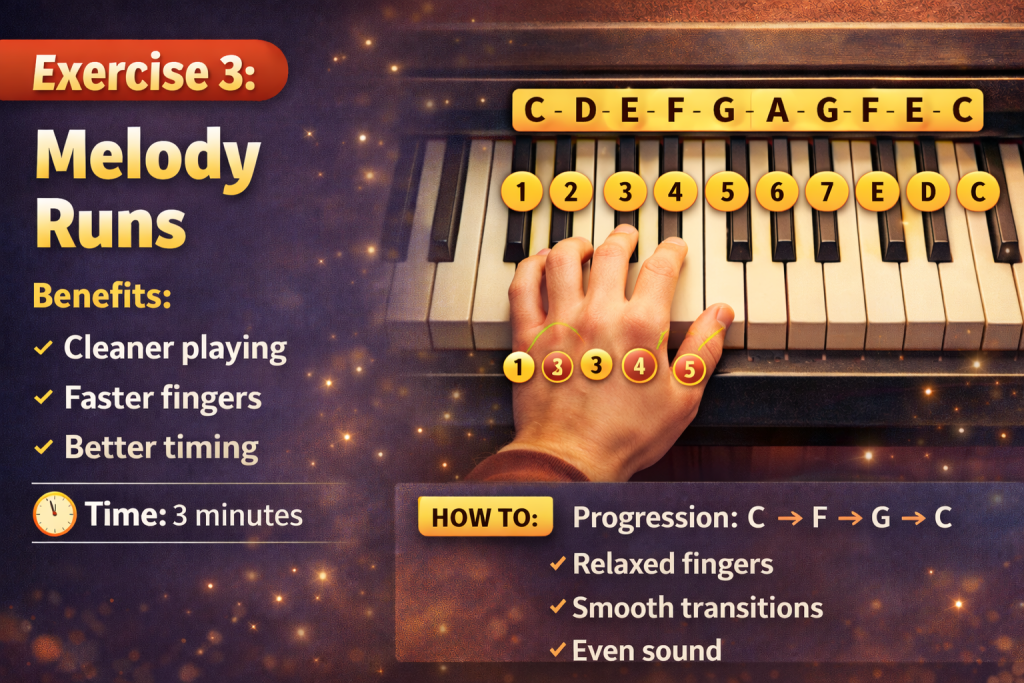
This develops fluency and finger agility.
Example pattern:
C–D–E–F–G–A–G–F–E–D–C
Tips:
- Start slow
- Keep rhythm steady
- Increase speed gradually
Benefits:
✔ Cleaner playing
✔ Faster fingers
✔ Better timing
⏱ Time: 3 minutes
Exercise 4: Hands Together Coordination

This trains your brain to sync both hands smoothly.
Method:
- Left hand: slow chord (C, F, or G)
- Right hand: simple melody notes
- Repeat slowly
Benefits:
✔ Eliminates confusion
✔ Prepares for real songs
✔ Improves rhythm
⏱ Time: 3 minutes
Exercise 5: Muscle Memory Loop (Fast Progress Hack)
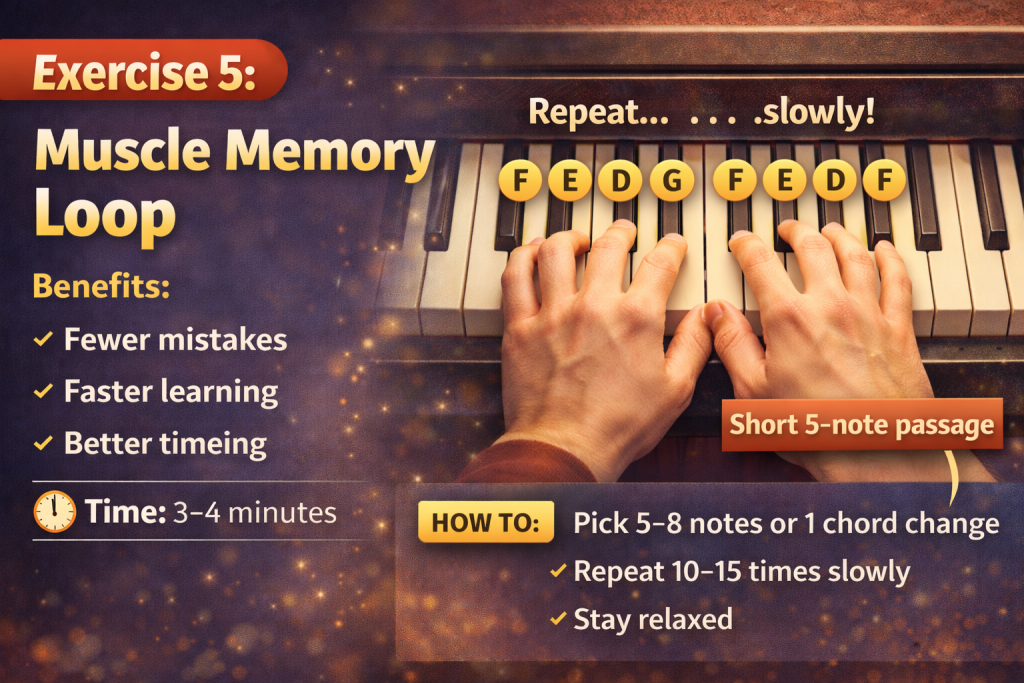
Short repetition builds automatic playing ability.
How:
- Pick 5–8 notes or one chord change
- Repeat slowly 10–15 times
- Focus on relaxed movement
Benefits:
✔ Fewer mistakes
✔ Faster learning
✔ Confident playing
⏱ Time: 3–4 minutes
15-Minute Daily Piano Practice Table (Quick Reference)
| Time | Exercise | Skill Developed |
|---|---|---|
| 0–2 min | Five-finger warm-up | Finger strength & accuracy |
| 2–5 min | Chord transitions | Song readiness |
| 5–8 min | Melody runs | Speed & smoothness |
| 8–11 min | Hands together | Coordination |
| 11–15 min | Muscle memory loop | Long-term improvement |
What You’ll Notice After 2 Weeks
✔ Easier hand movement
✔ Fewer missed notes
✔ Faster song learning
✔ Better rhythm
✔ More confidence
Common Practice Mistakes to Avoid
- Playing too fast, too soon
- Skipping warm-ups
- Practicing randomly
- Only using one hand
Smart, focused practice always wins.
Pro Tip for Busy Schedules
Attach piano practice to an existing habit:
☕ After coffee
📚 After work
🌙 Before bed
This makes consistency effortless.
Final Thoughts
You don’t need hours of practice to improve at the piano. What matters is focused daily effort. This 15-minute routine builds all the essential skills: strength, coordination, speed, and confidence without overwhelming your schedule.