
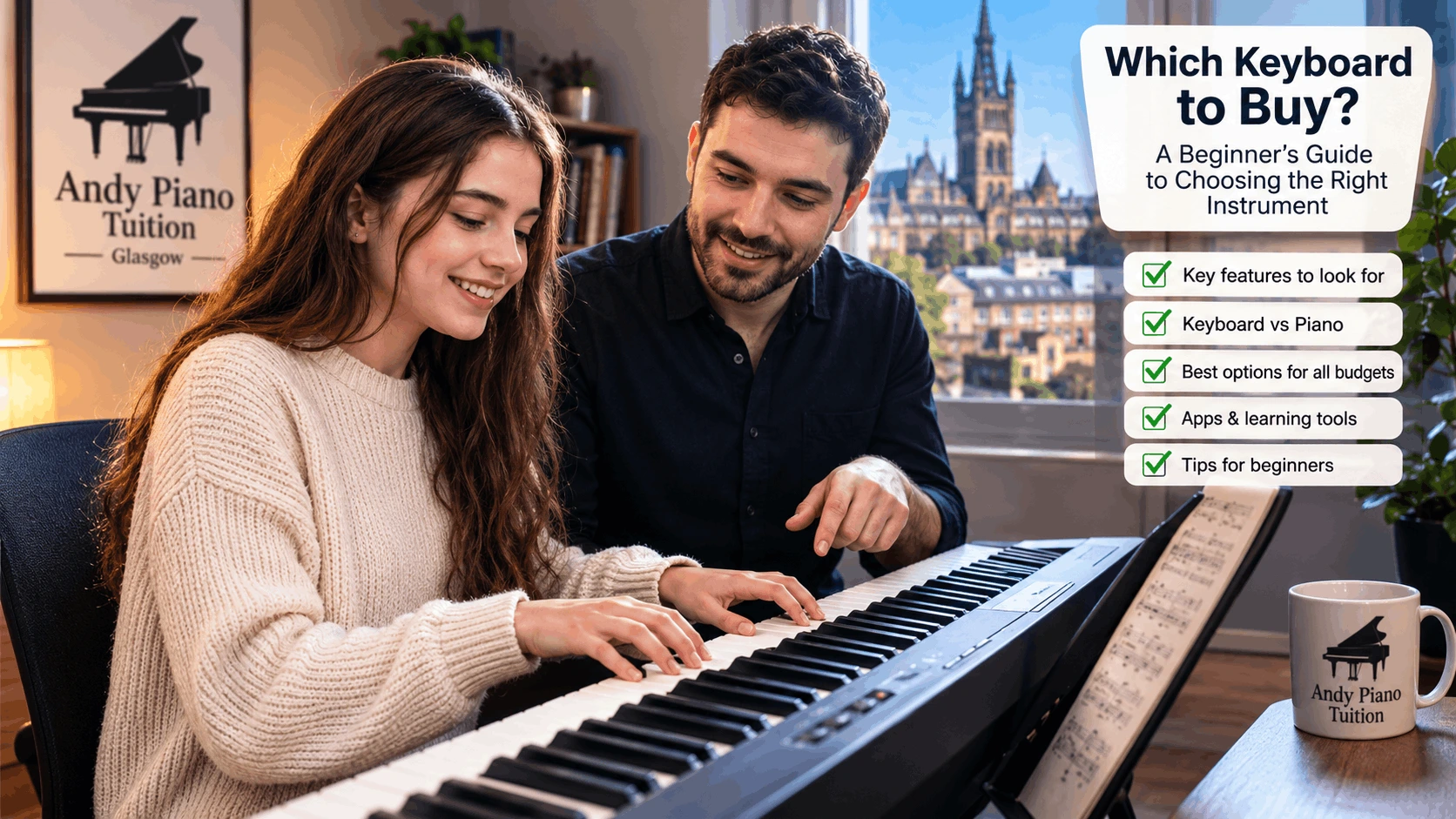
Choosing the right keyboard to learn piano is one of the most important decisions you will make at the start of your musical journey. At Andy Piano Tuition, we work with beginners across Glasgow every week, and one of the most common questions we hear is: “Which keyboard should I buy to start learning piano?”
This guide will walk you through everything you need to know, from key features to look for, to the best keyboards for different budgets and skill levels, so you can make a confident, informed choice.
Can You Learn Piano on a Keyboard?
Yes, you can absolutely learn piano on a keyboard. Many students at Andy Piano Tuition start their lessons on a keyboard before moving on to a digital or acoustic piano. A good keyboard can teach you the fundamentals of finger placement, hand posture, music theory, and reading sheet music.
That said, not all keyboards are created equal. Some are better suited to serious learning than others.
Differences Between a Keyboard and a Piano
| Feature | Keyboard | Piano |
|---|---|---|
| Number of keys | Usually 61 or 76 | Always 88 |
| Key weight | Often unweighted | Weighted (hammer action) |
| Sound production | Digital/synthesised | Acoustic strings or digital sampling |
| Portability | Lightweight, portable | Heavy, stationary |
| Price | Generally cheaper | Generally more expensive |
| Learning features | Often includes lesson modes, apps, lights | Rarely includes learning aids |
Pros and Cons of Learning on a Keyboard
Pros:
- Affordable entry point for beginners
- Portable and easy to store
- Often includes headphone jacks for quiet practice
- Many models come with built-in lessons and apps
- Great for testing your interest before investing in a full piano
Cons:
- Unweighted keys do not build the same finger strength as a real piano
- Smaller keyboards (61 keys) limit the pieces you can play
- Sound quality can be less rich than a digital or acoustic piano
Key Features to Look for in a Learning Keyboard
When our students at Andy Piano Tuition ask for keyboard recommendations, we always point them toward these core features.
Number of Keys (61, 76, or 88)
A standard piano has 88 keys. If you are serious about progressing to piano-level playing, an 88-key keyboard will serve you best long term. However, a 76-key or even 61-key keyboard can be a good starting point for young beginners or casual learners.
Weighted vs Semi-Weighted vs Unweighted Keys
| Key Type | Description | Best For |
|---|---|---|
| Weighted (hammer action) | Mimics the resistance of an acoustic piano | Serious learners, exam preparation |
| Semi-weighted | Some resistance, lighter than hammer action | Intermediate learners |
| Unweighted (synth action) | Light, springy touch | Absolute beginners, casual use |
Touch Sensitivity (Velocity-Sensitive Keys)
Touch sensitivity, also called velocity sensitivity, means the keyboard produces louder or softer sounds depending on how hard you press. This is essential for developing dynamic control, a skill we focus on heavily in Andy Piano Tuition lessons.
Built-in Lesson Modes and Learning Apps
Many modern keyboards connect to apps or have built-in lesson modes with light-up keys. These can be a helpful supplement to structured lessons, but they should never replace proper piano tuition.
Polyphony (Note Count)
Polyphony refers to how many notes a keyboard can produce at once. Look for at least 64-note polyphony so chords and sustained notes do not cut out.
Sound Quality and Voices
A wide range of instrument voices and realistic piano tone will keep practice sessions enjoyable, especially for younger students.
Connectivity (MIDI, Bluetooth, USB)
If you plan to use apps or connect to a computer for recording or notation software, check for USB-MIDI or Bluetooth MIDI support.
Portability and Size
If you are short on space or plan to travel with your keyboard, weight and size matter. Portable keyboards are lighter but often sacrifice weighted keys.
Types of Keyboards for Learning Piano
- Digital keyboards: Entry-level, affordable, often unweighted
- Portable/arranger keyboards: Include auto-accompaniment features and multiple sounds
- Digital pianos: Closest to an acoustic piano in feel and sound, usually weighted
- MIDI controller keyboards: Require a connected device or software, no built-in speakers
- Synthesizers: Designed for sound creation, not ideal for piano beginners
How Many Keys Do You Need to Learn Piano?
| Keys | Suitable For | Limitations |
|---|---|---|
| 61 keys | Young beginners, casual learners | Cannot play many full piano pieces |
| 76 keys | Intermediate learners | Still missing the top octave |
| 88 keys | All levels, exam preparation | Larger, heavier, pricier |
At Andy Piano Tuition, we generally recommend that students preparing for grades or exams invest in an 88-key keyboard or digital piano as early as possible.
Do You Need Weighted Keys to Learn Piano?
Weighted keys are not mandatory to begin learning, but they become important as you progress. Unweighted keys can create habits that make transitioning to an acoustic piano more difficult later on, particularly with finger strength and dynamic control.
If your budget allows, choose a semi-weighted or fully weighted keyboard from the start. If not, an unweighted model is still a reasonable way to begin.
Best Apps and Software to Learn Piano on a Keyboard
- Simply Piano: Popular app with guided lessons and real-time feedback
- Flowkey: Offers a large song library with step-by-step tutorials
- Yousician: Gamified learning experience with instant feedback
- Skoove: Structured lessons with sheet music integration
- Built-in lesson modes: Many keyboards come with their own guided practice tools
While these apps are useful for practice between sessions, they work best alongside structured lessons like those offered at Andy Piano Tuition, where a qualified teacher can correct technique and tailor your learning path.
How to Start Learning Piano on a Keyboard (Step-by-Step)
- Set up your keyboard in a quiet space with good lighting and a stable stand
- Learn proper hand position and posture before jumping into songs
- Understand basic sheet music notation, including note names and rhythm
- Practice scales and simple chords to build finger strength and coordination
- Create a consistent practice routine, ideally 15 to 30 minutes daily
- Book lessons with a qualified teacher to correct habits early and progress faster
Keyboard vs Digital Piano vs Acoustic Piano: Which Should You Choose?
| Factor | Keyboard | Digital Piano | Acoustic Piano |
|---|---|---|---|
| Price | Lowest | Mid-range | Highest |
| Portability | High | Low to moderate | None |
| Key feel | Light/unweighted | Weighted, realistic | Weighted, authentic |
| Maintenance | None | Minimal | Requires tuning |
| Best for | Beginners, casual learners | Serious students | Long-term commitment, exams |
For most beginners starting lessons with Andy Piano Tuition, a good quality keyboard or entry-level digital piano is the ideal starting point, with the option to upgrade as skills develop.
Common Mistakes Beginners Make When Choosing a Keyboard
- Buying a keyboard with fewer than 61 keys, which limits musical range
- Ignoring key weight and touch sensitivity
- Choosing a toy keyboard instead of a proper learning instrument
- Overspending on features that are not needed at the beginner stage
- Skipping professional lessons and relying only on apps
Frequently Asked Questions (FAQs)
Can a beginner learn piano on a 61-key keyboard? Yes, a 61-key keyboard is enough to begin learning, though you will eventually need more keys to play advanced pieces.
Is it better to learn on a keyboard or real piano? A real piano offers the most authentic learning experience, but a good quality keyboard is a practical and affordable alternative, especially when paired with lessons from Andy Piano Tuition.
How much should I spend on a keyboard to learn piano? Beginner keyboards typically range from budget-friendly entry models to higher-end options with weighted keys. Your budget should reflect how serious you are about long-term learning.
Do keyboards come with learning apps? Many modern keyboards include compatibility with learning apps such as Simply Piano or Flowkey, though not all models offer this.
Can I switch from keyboard to piano later without issues? Yes, though students who start on unweighted keyboards may need extra time adjusting to the feel of weighted piano keys. Our teachers at Andy Piano Tuition help students make this transition smoothly.
Conclusion: Choosing the Right Keyboard for Your Piano Journey
Selecting the right keyboard to learn piano depends on your budget, goals, and how serious you are about progressing. Whether you choose a simple 61-key keyboard or invest in an 88-key weighted model, the most important factor in your success will always be consistent practice and proper guidance.
At Andy Piano Tuition, we help students in Glasgow choose the right instrument and build strong foundations from day one. If you are ready to start your piano journey, get in touch with Andy Piano Tuition today to book your first lesson.