

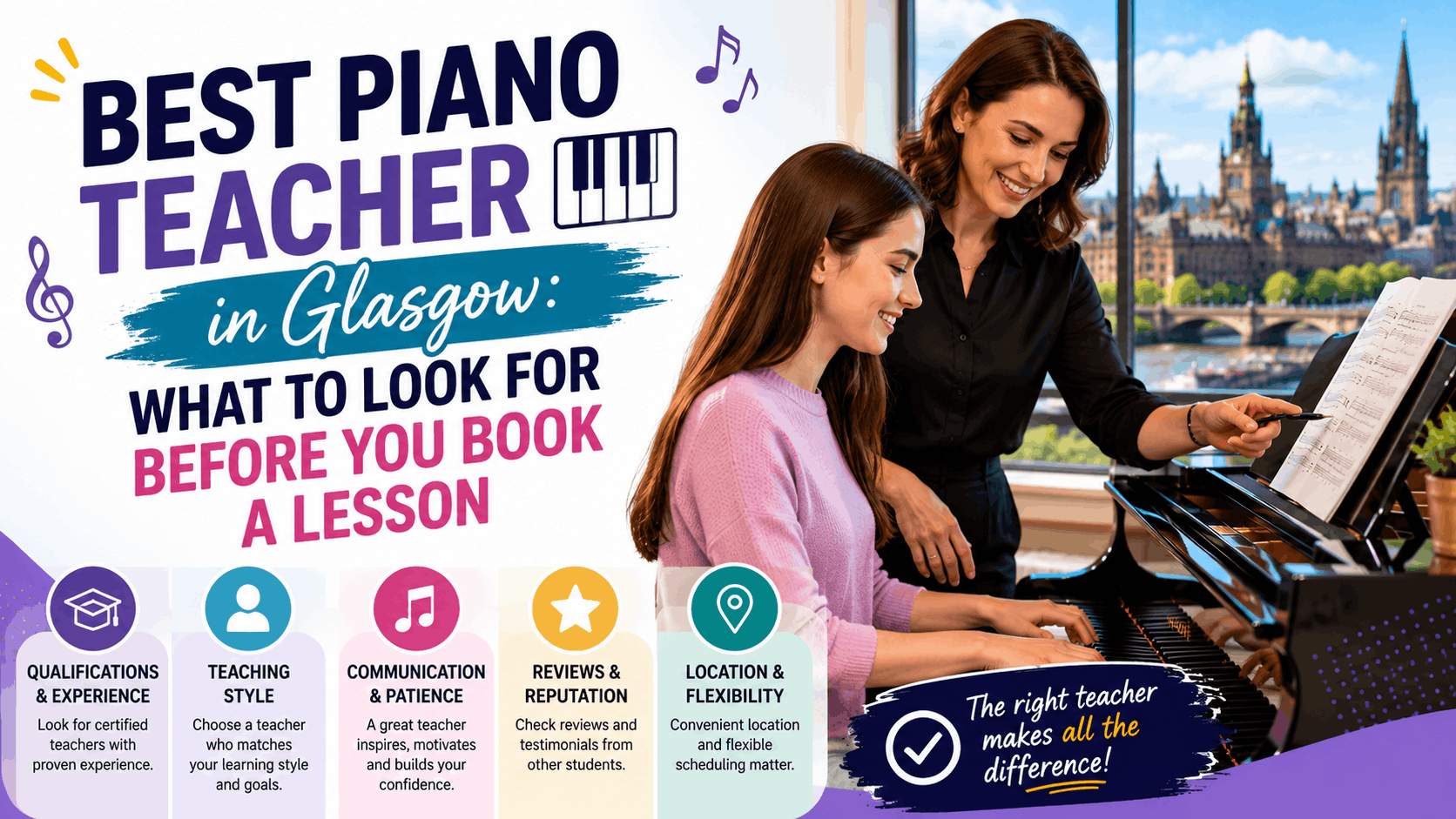
Searching “best piano teacher in Glasgow” usually turns up a long list of names, star ratings, and near-identical bios. What it doesn’t tell you is what actually separates a teacher who gets students to Grade 5 in eighteen months from one who leaves them stuck at “Twinkle Twinkle” for a year. This guide breaks down exactly what to check before you book — qualifications, teaching style, trial lessons, and the questions most people forget to ask.
At Glasgow Andy Piano, this is the exact vetting process we put every teacher through before they’re allowed to take on a student, so what follows isn’t theoretical — it’s the checklist we use ourselves. You can see how it plays out in practice on our homepage.
Why “Best” Is the Wrong Question to Start With
There is no single best piano teacher in Glasgow — there’s a best piano teacher for you. A retired grade-8 pianist who trained at the Royal Conservatoire of Scotland might be the perfect fit for a serious teenage exam candidate and a poor fit for a nervous 6-year-old who needs patience and games before technique. Before you evaluate any teacher, it helps to be honest about who’s actually learning: a child, a beginner adult, a returning player, or an exam candidate. Each of these needs a genuinely different teaching approach, not just a friendlier tone.
Qualifications That Actually Matter
Formal Training vs. Self-Taught Teachers
Glasgow has an unusually high concentration of conservatoire-trained musicians thanks to the Royal Conservatoire of Scotland, so it’s reasonable to expect a teacher with either a music degree, ABRSM/Trinity diploma, or documented performance background. This doesn’t mean self-taught or informally trained teachers can’t be excellent — some are — but formal training is a faster way to confirm they understand technique, not just repertoire.
Exam Board Experience (ABRSM, Trinity, SQA)
If exams are even a possibility down the line, ask directly whether the teacher has prepared students for ABRSM, Trinity College London, or Scotland’s SQA National 5 and Higher Music qualifications. A teacher who has taken multiple students through Grade 5 or Higher Music will know the common failure points — sight-reading nerves, weak left-hand technique, panic in aural tests — long before they become a crisis.
What a Genuinely Good Trial Lesson Looks Like
A trial lesson should never be a sales pitch dressed up as a lesson. It should tell both sides something real. Here’s what to look for:
| Trial Lesson Element | Why It Matters |
|---|---|
| Assessment of current level | A good teacher tests reading, rhythm, and hand position before assuming a starting point |
| Clear explanation of teaching method | Shows whether they use a structured method book, improvisation-first approach, or a hybrid |
| Discussion of goals | Exam prep, hobby playing, and songwriting need different lesson structures entirely |
| Feedback on posture and hand position | Bad habits formed early are the hardest to unlearn later |
| No pressure to commit immediately | A confident teacher lets the lesson speak for itself |
Glasgow Andy Piano structures every trial lesson around exactly this list, which is why most new students can tell within one session whether the teacher fits their learning style. You can get in touch to arrange a trial lesson if you’d like to see it firsthand.
Teaching Style: Structured, Improvisation-Led, or Hybrid
Not every excellent teacher teaches the same way, and mismatched style is the single biggest reason students quit within the first three months. Broadly, most Glasgow piano teachers fall into one of three camps:
- Method-book structured — progresses through a set curriculum (e.g. traditional graded method books), ideal for exam-focused or highly organised learners
- Improvisation and ear-led — builds musicality and chord knowledge before formal notation, better suited to adults, songwriters, and jazz-curious students
- Hybrid — blends structured technique with creative playing, often the best fit for children who need both discipline and enjoyment
Location, Instrument, and Practical Logistics
Real Piano vs. Digital Keyboard in Lessons
Ask what instrument the teacher actually teaches on. A teacher working from a full acoustic grand or upright gives students a genuinely different tactile experience than one teaching entirely on a digital keyboard — touch sensitivity, pedal response, and dynamic control all differ. If exam preparation is a goal, this matters even more, since exam boards assess touch and tone on a real instrument.
Where in Glasgow Are They Based?
Commute time is one of the most underrated reasons lessons get cancelled and eventually abandoned. Teachers based in the West End, Southside, and City Centre each serve different parts of the city — check this before falling in love with a teacher’s bio, only to find they’re a 45-minute drive away with no online option.
Red Flags to Watch For
- No willingness to offer any kind of trial or introductory lesson
- Vague or evasive answers about qualifications
- No structured plan — every lesson feels improvised with no long-term direction
- Pressure to sign up for a long-term contract before a single lesson has happened
- No visible experience with the exam board or goal you actually care about
Questions to Ask Before You Book
- What’s your training background and performance experience?
- How do you structure lessons for someone at my (or my child’s) level?
- Do you prepare students for ABRSM, Trinity, or SQA exams?
- What happens if we need to reschedule or pause lessons?
- Is there a recital or performance opportunity built into your teaching?
- Do you teach on an acoustic instrument, and can I see it beforehand?
How Glasgow Andy Piano Approaches This
Glasgow Andy Piano was built around solving exactly the problem this article describes: too many students in Glasgow were choosing a teacher based on price or proximity alone, then quitting within months because the teaching style didn’t match how they actually learn. Every new student is matched to a teacher based on goals, age, current level, and preferred teaching style — not just availability.
If you’d rather skip the guesswork, get in touch and we’ll match you with the right teacher based on your goals, schedule, and learning style — no pressure, no long-term contract required upfront.
Frequently Asked Questions
How do I know if a piano teacher in Glasgow is actually qualified?
Ask directly about formal training (music degree, conservatoire study, or ABRSM/Trinity diploma) and request examples of past students’ exam results or progress if relevant.
Should I choose a teacher based on reviews alone?
Reviews are useful for ruling out red flags, but they rarely tell you whether a teaching style matches your learning preferences — a trial lesson is far more reliable.
Is it better to choose a teacher near my home or the most qualified teacher in the city?
Consistency beats prestige. A slightly less decorated teacher who’s easy to get to every week will produce better results than an outstanding teacher you see irregularly because of a long commute — unless online lessons bridge that gap.

