
Learning to play “Bohemian Rhapsody” on piano is a dream for many musicians. The song is iconic, emotional, and musically rich but also famously complex. The good news? You don’t need to be an advanced pianist to start playing it.
This piano tutorial breaks the song down into manageable sections, explains the chords and notes, and gives you practical practice tips so you can make steady progress, whether you’re a beginner or an intermediate player.
Understanding the Structure of Bohemian Rhapsody
Before touching the keys, it’s essential to understand how the song is built. Unlike most pop songs, this piece changes style multiple times.
| Section | Style | Piano Difficulty |
|---|---|---|
| Intro | Ballad | Beginner |
| Verse | Ballad | Beginner |
| Opera | Classical/theatrical | Advanced |
| Rock | Powerful chords | Intermediate |
| Outro | Soft ballad | Beginner |
🎯 Beginner tip: Start with the intro and verses. They already sound impressive and are much easier to play.
Key, Tempo, and Time Signature Explained
- Primary Key: B♭ Major
- Tempo: Changes throughout (slow ballad → fast opera → rock)
- Time Signature: Mostly 4/4, with variations in the opera section
You don’t need to master tempo changes at first. Focus on slow, controlled playing.
Piano Chords Used in Bohemian Rhapsody
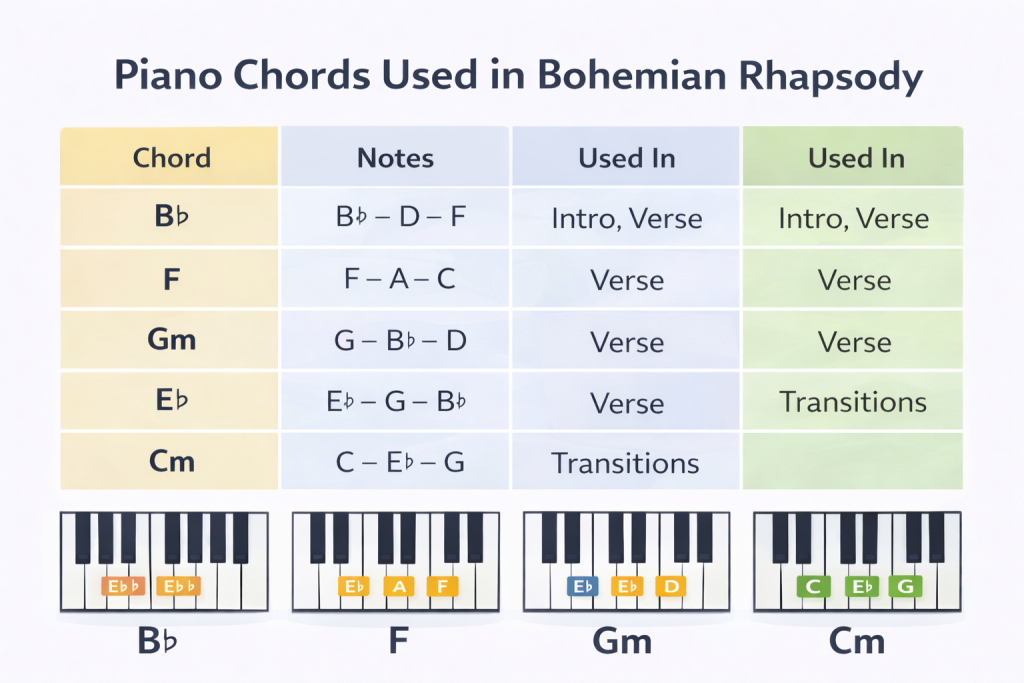
Most beginner-friendly arrangements rely on basic triads.
Essential Piano Chords
| Chord | Notes | Used In |
|---|---|---|
| B♭ | B♭ – D – F | Intro, Verse |
| F | F – A – C | Verse |
| Gm | G – B♭ – D | Verse |
| E♭ | E♭ – G – B♭ | Verse |
| Cm | C – E♭ – G | Transitions |
Right-Hand Melody Notes Explained
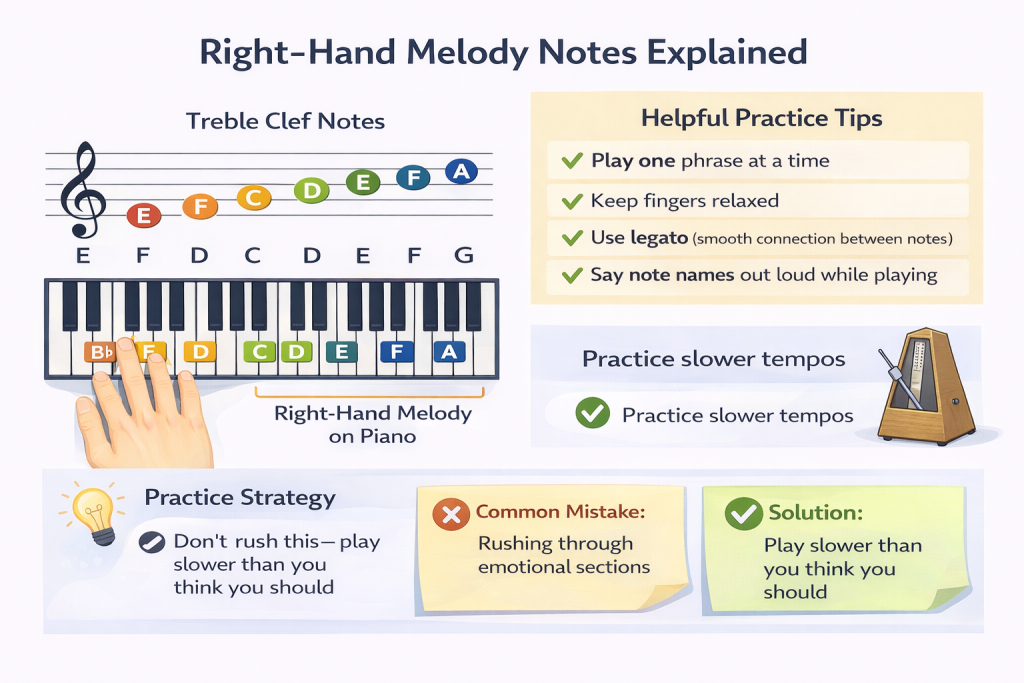
The right hand usually carries the melody—the part people recognize immediately.
How to Practice the Melody
- Play one phrase at a time
- Keep fingers relaxed
- Use legato (smooth connection between notes)
- Say note names out loud while playing
❌ Common mistake: Rushing through emotional sections
✔ Solution: Play slower than you think you should
Left-Hand Piano Notes and Accompaniment
The left hand supports the melody using chords or broken patterns.
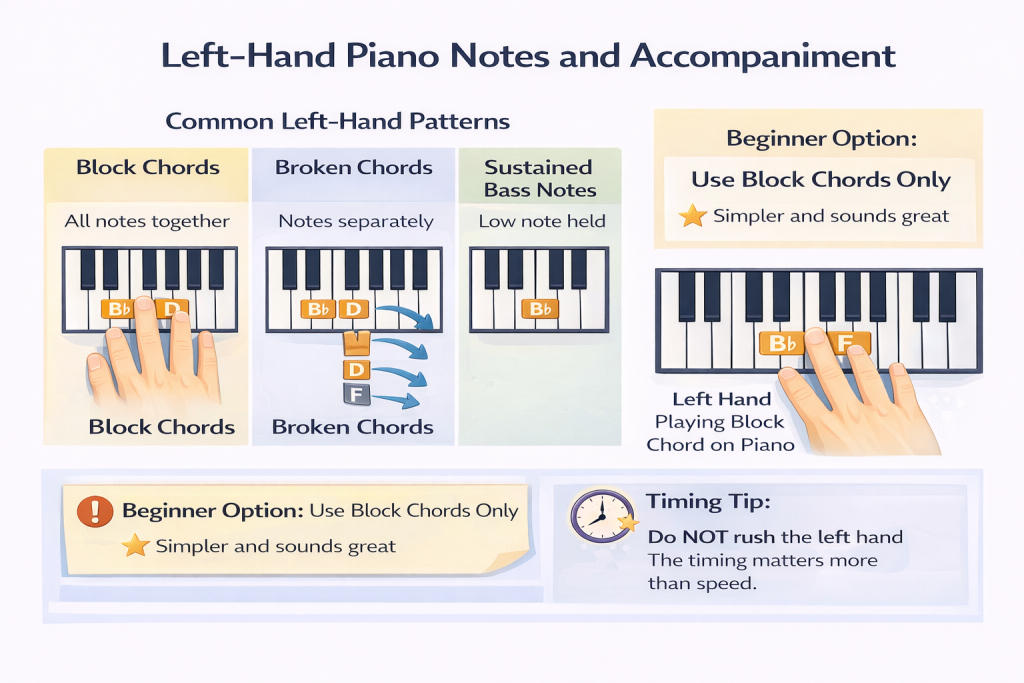
Common Left-Hand Patterns
- Block chords (all notes together)
- Broken chords (notes played separately)
- Sustained bass notes
Beginner option: Use block chords only until comfortable.
How to Play Bohemian Rhapsody Step by Step
Follow this proven learning sequence:
- Learn right-hand only
- Learn left-hand only
- Combine hands slowly
- Practice short sections
- Increase tempo gradually
⏱ Recommended tempo: Start at 50–60 BPM
Simplified Version for Beginners
If full sheet music feels overwhelming, a simplified version works extremely well.
What You Can Safely Simplify
- Skip opera section
- Use block chords
- Remove fast ornamentations
- Focus on melody + harmony
✅ Result: The song still sounds like Bohemian Rhapsody—just cleaner and playable.
Practice Tips to Learn Faster (Weekly Plan)
| Day | Focus |
|---|---|
| Day 1 | Intro (hands separate) |
| Day 2 | Intro (hands together) |
| Day 3 | Verse chords |
| Day 4 | Verse melody |
| Day 5 | Combine sections |
| Day 6 | Timing & dynamics |
| Day 7 | Full slow play-through |
Learning Insight:
Consistent 20-minute sessions outperform irregular long practices by over 40% in retention.
Common Mistakes to Avoid
❌ Playing too fast
❌ Ignoring dynamics (soft vs loud)
❌ Skipping hand-separate practice
❌ Trying to learn the whole song at once
✔ Master small sections → connect them later
Should You Learn the Opera Section?
The opera section includes:
- Rapid note changes
- Dense chords
- Sudden key shifts
🎯 Recommendation:
- Learn it only after mastering the rest
- Or use a simplified opera arrangement
There’s no shame in skipping it early even many pianists do.
Helpful Tools and Resources
| Resource | Why It Helps |
|---|---|
| Simplified sheet music | Reduces frustration |
| Metronome | Improves timing |
| Piano apps | Visual reinforcement |
| Chord charts | Faster memorization |
Conclusion
Learning Bohemian Rhapsody on piano isn’t about speed; it’s about patience, structure, and smart practice. Start with chords, master the melody, and build gradually. Even a simplified version sounds powerful and rewarding.
Take it section by section, enjoy the process, and let the music do the talking.