
Does piano prevent brain ageing? It is a fair question, especially if you live in Glasgow and want a hobby that feels enjoyable rather than another chore on the health list. The honest answer is encouraging but not magical. Piano playing will not guarantee protection from dementia, yet learning and practising piano can challenge memory, attention, coordination, hearing, emotion and social confidence all at once. That is why many adults are now looking at local lessons from Glasgow Piano Tuition as more than a musical goal. It can also become a meaningful habit for keeping the mind active.
Table of Contents
Quick answer for busy readers
Does piano prevent brain ageing in a direct medical sense? No single activity can do that. Brain ageing is shaped by genes, sleep, hearing, blood pressure, movement, diet, education, social connection and many other factors.
Still, the piano is unusually rich as a brain activity. You read notes, listen closely, move both hands, count rhythm, remember patterns and correct mistakes in real time. I find that surprisingly impressive because very few hobbies ask the brain to do so many small jobs at once while still feeling creative.
The best way to think about piano is this: it may support cognitive reserve, brain flexibility and everyday mental sharpness. It is not a cure, and it should sit beside normal medical advice, physical activity and social connection.
| Topic | Simple Explanation |
| Main question | Not completely, but it may support healthy ageing |
| Simple answer | Not completely, but it may support healthy aging |
| Best benefit | Memory, focus, coordination and mental sharpness |
| Best practice routine | Short practice sessions on most days |
| Good fit | Adults, seniors and beginners who enjoy music |
| Main limitation | Piano is not a cure for dementia or memory loss |
What changed in the research by 2026
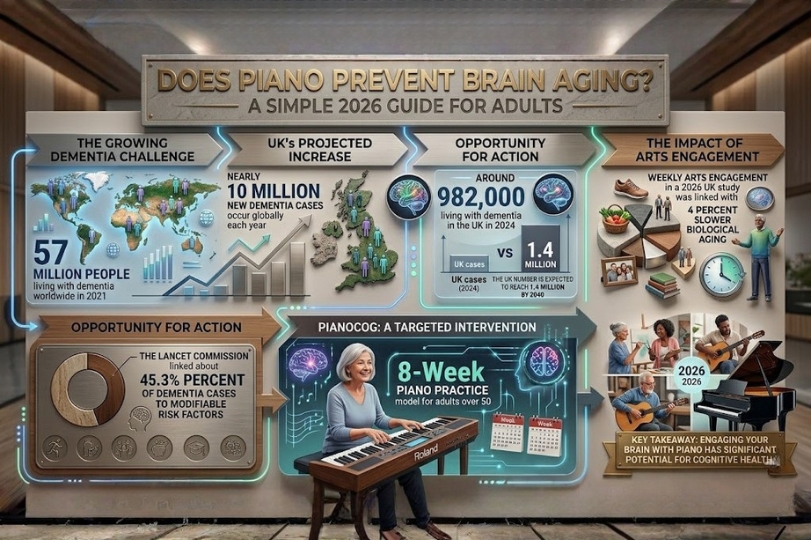
The bigger picture is that scientists are paying more attention to creative activity and brain health. The World Health Organisation reported that 57 million people were living with dementia globally in 2021, with nearly 10 million new cases each year. In the UK, Alzheimer’s Society estimates that 982,000 people were living with dementia in 2024, with that number expected to reach 1.4 million by 2040. That makes prevention and delay a serious public health topic, not just a personal worry.
The 2024 Lancet Commission estimated that about 45.3 per cent of dementia cases are linked to 14 modifiable risk factors. Piano was not listed as a magic shield, of course, but cognitive activity and social engagement sit comfortably within the broader prevention conversation. That is why the question of whether the piano can delay cognitive decline is not silly. It is a careful question with a cautious answer.
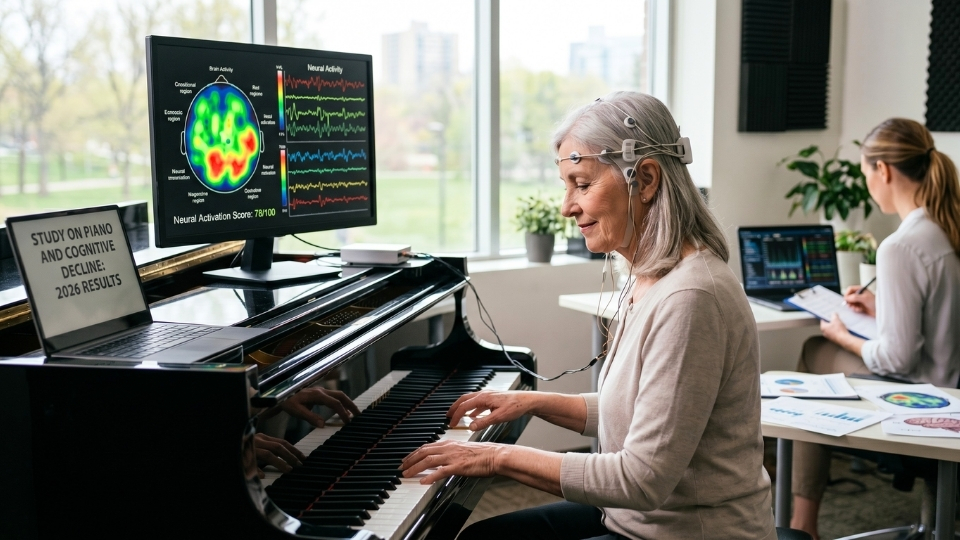
By 2026, one of the most relevant newer signs came from PIANO Cog, a remote piano programme for adults over 50. Trial registration material described an 8-week home practice plan with 30 minutes of piano practice on 5 days each week, plus cognitive testing and brain imaging before and after the programme. The early 2026 feasibility report said short-term remote piano training was feasible for healthy adults over 50. That does not prove prevention, but it does show researchers are taking piano seriously as a structured cognitive intervention.
Another 2026 study from University College London examined arts and cultural engagement more broadly among 3,556 UK adults. Weekly arts participation was linked with a 4 per cent slower pace of biological ageing, while monthly engagement was linked with a 3 per cent slower pace. The biggest boost was seen in people aged 40 and over. I was genuinely surprised by how measurable that finding was, even though it still shows an association rather than a guaranteed cause-and-effect.
Why does the piano feel different from ordinary brain games
Many brain exercises for seniors can feel like homework. Piano is different because it gives feedback instantly. A note sounds right or wrong. A rhythm either settles or falls apart. Your hands tell you what your eyes missed.
This is why piano as a mental workout makes sense. It asks for layered thinking:
- Reading symbols on the page
- Matching notes to keys
- Moving the left and right hands in different patterns
- Listening for tone and timing
- Remembering what improved last time
- Managing frustration when progress feels slow
I remember sitting beside an older beginner who laughed after playing the same bar six times. On the seventh try, it finally landed. The relief on their face said a lot. It was not just about the music. It was the pleasure of the brain solving a puzzle with the body.
How the piano may support memory
People often ask how playing the piano affects memory in older adults, as memory changes are among the first things many notice with age. You forget a name, misplace your glasses or walk into a room and wonder why you went there. That can be unsettling.
Piano practice uses several memory systems. There is visual memory for notes, muscle memory for finger movements, auditory memory for melody and working memory for keeping the next few beats in mind. This makes piano practice and mental sharpness feel more practically connected.
A 2025 paper in GeroScience reported that older adults with a history of playing a musical instrument showed small but meaningful advantages in working memory and executive function, with effect sizes of 0.24 and 0.17. Those numbers are not huge, but in ageing research, small advantages can matter when they add up with other healthy habits.
What brain imaging is showing
Scientific research on piano and brain ageing has moved beyond simple memory tests. Researchers are now asking what happens inside the brain when older musicians listen, process and respond.
A 2025 PLOS Biology study found that older musicians exhibited more youth-like patterns of brain connectivity during speech-in-noise tasks than older non-musicians. The authors suggested that long-term musical training may support cognitive reserve and help the brain handle age-related listening demands more efficiently.
The wider topic of piano and neurocognitive health matters because real-life listening is hard. Think of a busy cafe in the West End, a family dinner in Shawlands or a train announcement at Glasgow Queen Street. Hearing, attention and prediction all work together. Piano cannot fix hearing loss, but music training for healthy brain ageing may support the listening brain in ways ordinary puzzles do not.
This is also where neuroplasticity and piano playing come in. Neuroplasticity simply means the brain can adapt through repeated use. You do not need to become a concert pianist for that idea to matter. Even learning a simple tune asks the brain to form and refine connections.
Does playing the piano prevent brain ageing and reduce the risk of dementia?
Does piano prevent brain ageing enough to stop dementia? That would be too strong. Preventing dementia through piano sounds appealing, but the evidence does not support that claim on its own.
A better answer is that the piano may be part of a brain-healthy lifestyle. It can sit beside:
- Regular walking or other movement
- Good hearing care
- Social contact
- Sleep support
- Blood pressure and cholesterol checks
- Balanced food
- Enjoyable learning
Research reviews in 2025 still described the evidence on music-making and older adults’ brain plasticity as limited and mixed, with studies varying in size, methods, and quality. That made me relieved, in a way, because good science should not oversell a lovely idea just because we want it to be true.
Piano and mood also matter
Brain health is not only about memory scores. Mood, confidence and identity matter too. For many older adults, learning piano brings a quiet feeling of achievement. You start with one hand, add the second, and suddenly a song appears.
There is also social value. Lessons provide structure and encouragement. Playing for a friend, partner, or grandchild can feel warm and personal. Cognitive ageing and musical activity often overlap with well-being, as the brain functions better when life feels engaged and meaningful.
Music therapy for ageing brains is a related area, especially for people already living with dementia or mild cognitive impairment. Piano lessons are not the same as clinical therapy, but both show how music can reach attention, emotion and memory in a human way.
Is piano better than apps, puzzles or choir
Piano is not the only option. Some people will prefer singing, dancing, art groups, walking clubs or language learning. The best activity is usually the one you will actually keep doing.
| Option | Best For | Main Strength | Limitation |
| Glasgow Piano Tuition | Adults in Glasgow | Personal support and guidance | Not a medical memory care service |
| Keyboard learning apps | People who prefer solo learning | Flexible and easy to access | Less personal feedback |
| Community music groups | Social learners | Encourages connection and mood | Less focus on piano technique |
| Puzzle apps | Quick daily brain exercises | Simple and convenient | Can feel repetitive over time |
What Glasgow adults should look for in lessons
Whether piano prevents brain ageing is only useful if it leads to practical choices. For adults in Glasgow, the right lesson style matters more than chasing perfect results.
Look for a teacher who:
- Works at your pace
- Explains music clearly
- Welcomes adult beginners
- Gives small, achievable practice goals
- Helps you enjoy the process
- Understands that confidence can be fragile at first
Glasgow Piano Tuition is a good fit for learners who want human guidance, steady progress and a friendly route into piano. It is especially suitable if you are nervous about starting, returning after years away or learning for enjoyment rather than exams. The honest limitation is that it may not be the best option for someone who needs clinical memory care, formal music therapy or a completely free self-study route.
For people who want a low-pressure first step, the free classes page is a sensible place to explore what lessons feel like before committing.
A simple practice plan for brain health
You do not need to practise for hours. In fact, older beginners often do better with short, calm sessions. Think of brain stimulation through piano as a repeated nudge rather than a dramatic boot camp.
Try this routine for four weeks:
- Practise for 15 to 25 minutes on most days
- Warm up with slow five-finger patterns
- Review one familiar tune
- Learn two new bars slowly
- Clap or count the rhythm out loud
- End by playing something you enjoy
This turns piano into one of your ageing brain memory exercises without making it feel clinical. Keep the mood light. Some days will sound clumsy. That is normal.
What 2026 studies on music and brain function suggest for beginners
The strongest evidence is not that piano reverses ageing. It is that learning music may combine several known ingredients of healthy ageing: challenge, repetition, reward, emotion, movement and sometimes social connection.
So, does learning piano keep your brain young? Not in a literal sense. But it may help you keep using skills that ageing can otherwise weaken, such as attention switching, listening, hand control and memory for sequences.
People searching for piano lessons for seniors’ cognitive health should also remember that enjoyment is not a bonus. It is part of the mechanism. When you enjoy a task, you return to it. When you return to it, your brain gets repeated practice.
Common mistakes to avoid
Some learners start with too much pressure. They buy a keyboard, choose a difficult song and then feel defeated after a week. That is not failure. It is just poor pacing.
Avoid these traps:
- Practising only when you feel motivated
- Measuring progress by speed
- Skipping rhythm
- Ignoring hand comfort
- Expecting memory to improve overnight
- Treating wrong notes as proof that you are not musical
Small steps are not childish. They are how the brain learns.
Conclusion
Does piano prevent brain ageing as a guaranteed outcome? No. As part of a wider, active and enjoyable lifestyle, it may help, and the 2026 picture is more promising than dismissive.
The strongest case for the piano is not hype. It is the blend of challenge, movement, listening, memory and feeling. For many adults in Glasgow, that blend is exactly what makes lessons worth trying. If you are curious, Glasgow Piano Tuition offers a local, supportive route into learning the piano that can be musical, social, and mentally engaging. The science is still developing, but learning a tune you love is a pretty good place to start.