

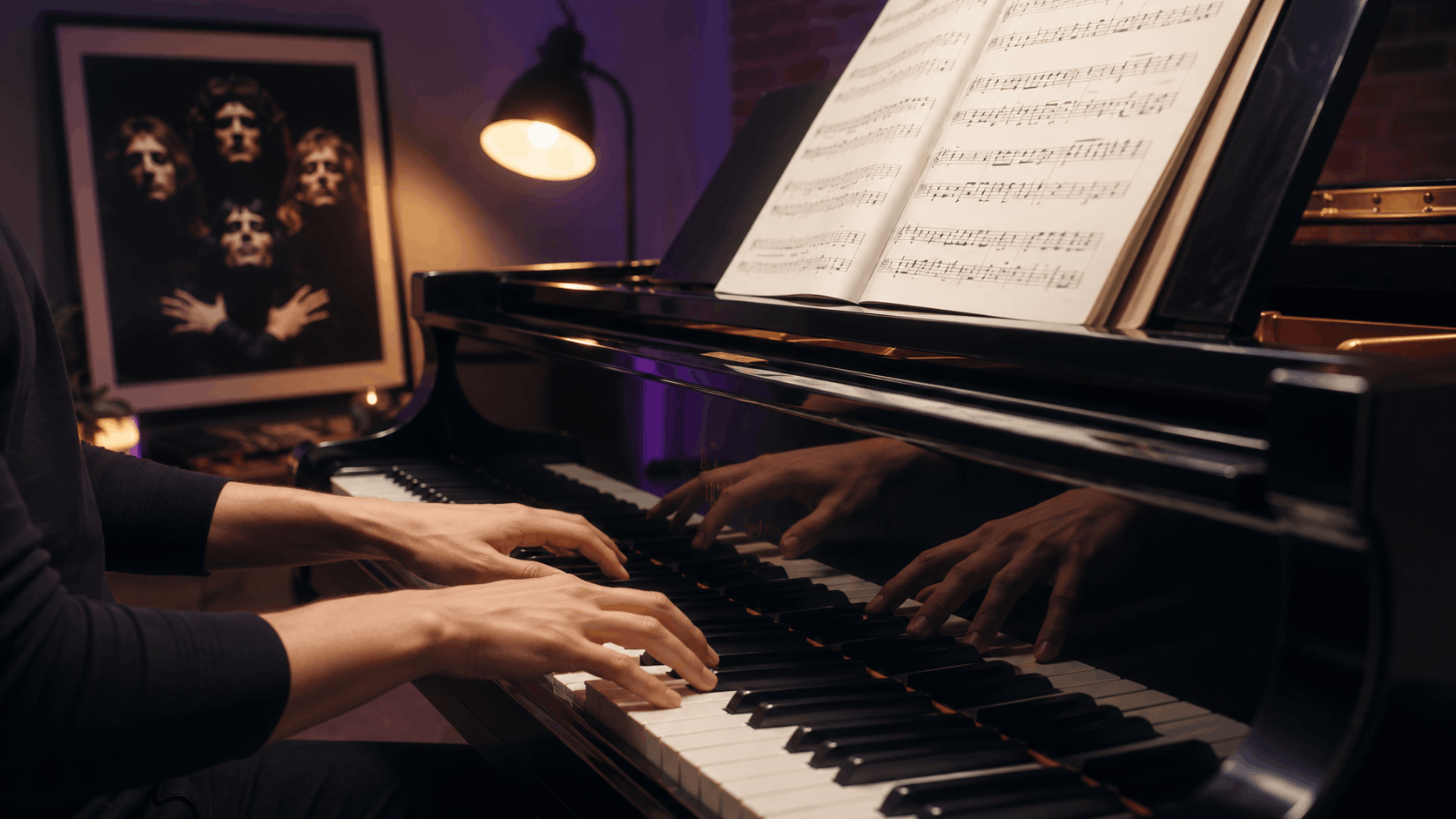
Learning how to play Bohemian Rhapsody on piano can seem intimidating. The music moves from a gentle ballad to an operatic passage, a powerful rock section and a quiet outro, with several changes in harmony, rhythm and dynamics along the way.
The best way to learn it is not to tackle the complete song from beginning to end. Instead, divide it into short musical sections, learn each hand separately and choose an arrangement that matches your present ability.
A beginner can start with the recognisable piano ballad using simplified chords. An intermediate pianist can then add the original accompaniment patterns, chromatic movement, hand crossings and more detailed transitions.
Is Bohemian Rhapsody Hard to Play on Piano?
The difficulty depends on the version you choose.
A simplified arrangement of the opening ballad can suit a beginner or early-intermediate pianist. You can play the melody in your right hand while holding basic chords or single bass notes in your left.
A fuller arrangement is considerably more demanding. It may require:
- Fast chord changes
- Hand independence
- Chord inversions
- Chromatic runs
- Sudden changes in articulation
- Careful pedal control
- Accurate rhythmic counting
- Quick movement between registers
Do not judge your progress by whether you can immediately play the entire recording. Learning the opening ballad cleanly and expressively is already a worthwhile achievement.
Understanding the Structure of Bohemian Rhapsody
The song does not follow a conventional verse-and-chorus format. It behaves more like a sequence of connected musical movements.
| Section | Main character | Suggested level |
|---|---|---|
| Vocal and piano introduction | Free, spacious and expressive | Early intermediate |
| Piano ballad | Lyrical melody with chordal accompaniment | Beginner to intermediate |
| Guitar transition | Gradual increase in intensity | Intermediate |
| Operatic section | Rapid rhythmic and harmonic changes | Intermediate to advanced |
| Hard-rock section | Strong accents and driving rhythm | Intermediate |
| Outro | Quiet arpeggios and controlled resolution | Early intermediate |
Beginners should learn the piano ballad first. After that, work on the outro, followed by a simplified rock section. Leave the operatic passage until your chord recognition and hand coordination are more secure.
What You Need Before Starting
Choose the Right Arrangement
There is no single correct arrangement for every pianist.
A beginner arrangement might contain:
- Right-hand melody
- Left-hand single bass notes
- Block chords
- Fewer chord inversions
- A simplified operatic passage
An intermediate arrangement may include fuller chord voicings, moving bass lines, octaves, hand crossings and more of the original rhythmic detail.
Choose a version that challenges you without forcing you to stop every few notes. A slightly easier arrangement played musically is better than an advanced arrangement played with constant tension and hesitation.
Become Comfortable With the Keyboard
Bohemian Rhapsody uses several black keys and changing tonal centres. You should be able to locate B-flat, E-flat and A-flat quickly without counting from C every time.
Learners who are still finding their way around the instrument should review these piano keyboard basics before beginning the song.
Decide How You Will Learn
You can learn from traditional sheet music, a chord chart, a visual tutorial or a combination of all three.
Sheet music gives you the clearest information about rhythm, note duration, rests and articulation. A chord chart is useful when you want to sing while accompanying yourself. Video can help with hand position, but it should not replace careful listening and rhythmic understanding.
This guide to reading music notes for piano can help if accidentals, ties or rhythmic values are slowing you down.
Bohemian Rhapsody Piano Chords and Key Changes
The opening and ballad material is strongly associated with B-flat major, but the complete song travels through several keys. That movement is one reason it sounds so dramatic.
Useful chords to recognise include:
| Chord | Notes |
|---|---|
| B♭ major | B♭–D–F |
| F major | F–A–C |
| F7 | F–A–C–E♭ |
| G minor | G–B♭–D |
| E♭ major | E♭–G–B♭ |
| C minor | C–E♭–G |
| A major | A–C♯–E |
These are not the only harmonies in the complete composition, but they give beginners a practical starting vocabulary.
Why Chord Inversions Matter
Playing every chord in root position forces your hands to jump unnecessarily. It can also make the accompaniment sound heavy and disconnected.
Instead, choose inversions that keep neighbouring chords close together. Look for common notes that can remain under the same finger while one or two other fingers move.
For example, if two consecutive chords share B-flat or F, try keeping that note in the same register. This creates smoother voice leading and reduces physical effort.
Practise each change without rhythm first:
- Form the first chord.
- Notice which notes remain the same.
- Move only the fingers that need to change.
- Repeat the movement slowly.
- Add the correct rhythm after the motion feels comfortable.
How to Play Bohemian Rhapsody on Piano Step by Step
Step 1: Learn the Left-Hand Accompaniment
Begin with the harmonic foundation rather than trying to play both hands immediately.
For a simplified version, play:
- Single bass notes
- Root-and-fifth shapes
- Block chords
- Slow broken chords
Keep your wrist flexible and avoid pressing harder than necessary. The left hand should support the melody rather than overpower it.
Once the basic harmony is secure, experiment with inversions and broken-chord patterns. Aim for an even tone across every note.
Step 2: Learn the Right-Hand Melody
Break the melody into short phrases. A useful phrase may be only two to four beats long.
For each phrase:
- Find a comfortable fingering.
- Play without pedal.
- Count the rhythm aloud.
- Repeat it slowly three to five times.
- Connect it to the next phrase.
Avoid using a different fingering on every repetition. Consistent fingering helps your hands develop reliable movement patterns.
Listen for where the melody rises, relaxes or becomes more intense. Correct notes are important, but phrasing is what makes the performance sound musical.
Step 3: Combine Both Hands
Do not immediately play at full speed.
Start with one short phrase and identify the exact moments when both hands play together. You can mark these vertical points in the sheet music or chord chart.
Use this process:
- Play the right hand alone.
- Play the left hand alone.
- Tap both rhythms on your knees.
- Combine the hands at a very slow tempo.
- Stop immediately when tension appears.
- Repeat the smallest difficult movement.
A metronome setting around 50 to 60 beats per minute can be useful for early coordination practice, although some expressive passages should eventually breathe more freely.
Step 4: Practise the Chromatic Movement
Chromatic passages move in half steps and create much of the song’s distinctive tension.
Do not try to memorise them as a random collection of notes. Look for the direction of travel:
- Which voice is descending?
- Which note remains fixed?
- Does the bass move by a half step?
- Is the hand shape repeating from a new position?
Play the outer notes first if a chord sequence feels too dense. Add the middle notes only after you understand the harmonic shape.
How to Play the Intro and Piano Ballad
The piano ballad should sound spacious, controlled and vocal.
First practise the accompaniment without the melody. Keep the chords connected, but do not blur them together with excessive pedal.
Next, play the melody alone and imagine that you are singing through the piano. Let longer notes settle instead of rushing toward the next phrase.
When combining the hands:
- Keep the melody slightly louder than the accompaniment.
- Release tension after each chord.
- Use a flexible wrist during repeated shapes.
- Slow down before difficult transitions.
- Practise joins between phrases, not only the phrases themselves.
The joins are often where hesitation occurs. Start one beat before a transition and finish one beat after it. Repeat this small unit until the movement becomes dependable.
How to Approach the Operatic Section
The operatic passage is difficult because its rhythms, accents and harmonies change quickly.
Beginners do not need to reproduce every vocal layer on the piano. Instead, create a reduced arrangement containing:
- The principal melodic line
- Important bass notes
- Strong chord accents
- Clear changes in dynamics
Practise the rhythm away from the keyboard first. Clap or speak the rhythm while maintaining a steady pulse.
Then practise one chord or hand position at a time. The section should feel theatrical and energetic, but speed must come after accuracy.
Use short practice loops of one or two bars. Once two neighbouring loops are reliable, connect them and practise the transition.
How to Play the Hard-Rock Section
The rock section needs energy, but energy does not mean stiffness.
Use a firm attack while keeping your wrists and shoulders loose. The chords should sound decisive rather than forced.
Focus on:
- Accurate accents
- Even repeated chords
- A stable pulse
- Clean releases
- Strong dynamic contrast
Practise the rhythm on a closed piano lid or tabletop before adding pitches. This helps separate the rhythmic challenge from the chord challenge.
If the original texture is too dense, play the bass note in your left hand and a compact chord in your right. This still produces a convincing rock sound.
How to Play the Outro
The final section should feel calmer and more reflective.
Reduce the dynamic level gradually instead of becoming suddenly quiet. Keep the arpeggios even and allow the melody to remain audible above the harmony.
Use less pedal as the texture becomes thinner. Listen carefully to the decay of the instrument and change the pedal whenever the harmony changes.
The ending is most effective when it sounds controlled and unhurried.
Fingering and Hand-Crossing Tips
Good fingering reduces unnecessary movement and makes difficult transitions more reliable.
Use these principles:
- Avoid stretching when the hand can move instead.
- Keep the thumb relaxed when it passes under the hand.
- Prepare the next hand position before you need it.
- Use the same fingering during each repetition.
- Practise hand crossings without rhythm first.
- Move from the arm rather than twisting the wrist.
If a passage consistently breaks down at the same point, the problem may be the fingering rather than a lack of practice.
Write finger numbers above only the notes where a decision is needed. Marking every note can make the page harder to read.
How to Use the Sustain Pedal
The sustain pedal adds warmth, but too much pedal can make the harmony muddy.
A practical method is:
- Play the chord.
- Press the pedal immediately after the notes sound.
- Hold it while the harmony remains unchanged.
- Release and replace it as the next chord arrives.
This is sometimes called changing or syncopated pedalling.
Practise without pedal first. If the notes cannot connect cleanly with your fingers, the pedal may hide rather than solve the problem.
Use less pedal during fast chromatic passages and strong rock chords. Use slightly more in slower ballad sections, while still clearing it whenever the harmony changes.
Easy Bohemian Rhapsody Piano Version for Beginners
A beginner does not need to play every instrumental and vocal detail.
Create a simplified performance by:
- Learning only the ballad and outro initially
- Playing single bass notes in the left hand
- Using block chords instead of broken patterns
- Removing inner chord notes
- Playing the principal melody rather than every vocal harmony
- Reducing the operatic passage to important chord accents
- Slowing difficult transitions
- Using smaller chord shapes
The goal is to preserve the melody, harmony and emotional shape of the music.
Once the simplified version feels comfortable, add one new detail at a time. You might add an inversion, a moving bass note, an octave or a more active accompaniment pattern.
Fourteen-Day Practice Plan
| Days | Main focus |
|---|---|
| 1–2 | Identify chords and choose consistent inversions |
| 3–4 | Learn the left-hand ballad accompaniment |
| 5–6 | Learn the right-hand melody in short phrases |
| 7 | Combine the first section slowly |
| 8 | Practise transitions and chromatic movement |
| 9 | Learn a simplified operatic passage |
| 10 | Practise the hard-rock rhythm |
| 11 | Learn the outro |
| 12 | Connect neighbouring sections |
| 13 | Work on dynamics, articulation and pedal |
| 14 | Record a slow complete performance |
A focused 15- to 25-minute session is enough when it has a clear objective. The daily piano exercises for busy professionals can also help you improve chord changes, hand coordination and finger control.
Common Problems and Solutions
The Chord Changes Sound Uneven
Practise only the movement between two chords. Remove the rhythm and move as slowly as necessary. Choose closer inversions if your hand is jumping across the keyboard.
The Melody Disappears
Play the right hand slightly louder and reduce the weight of the left hand. Practise exaggerating the dynamic difference before making it more natural.
Both Hands Fall Apart
Reduce the passage to one or two beats. Identify the notes that occur together and practise those points as still hand positions before restoring the rhythm.
The Pedal Makes Everything Muddy
Change the pedal with each harmony. Practise the passage without pedal and add it only after the finger connection is secure.
The Opera Section Feels Impossible
Reduce it to the main melody, bass notes and important accents. Master the rhythm before restoring additional notes.
Progress Has Stopped
Record yourself. Listening away from the keyboard often reveals uneven timing, excessive pedal or hidden pauses that are difficult to notice while playing.
When a Piano Teacher Can Help
Online tutorials can show you which keys to press, but they cannot always identify why a particular movement feels uncomfortable.
A teacher can correct inefficient fingering, unnecessary tension, uneven chord voicing and inaccurate pedal changes before these habits become established.
For learners who want individual help with this song, a tailored piano lesson in Glasgow can turn difficult passages into smaller, practical exercises suited to the learner’s experience and musical goals.
Frequently Asked Questions
Can a beginner play Bohemian Rhapsody on piano?
Yes. A beginner can learn a simplified version of the ballad using the melody, single bass notes and basic block chords. The complete original-style arrangement is more suitable for an intermediate or advanced player.
What key is Bohemian Rhapsody in?
The song begins around B-flat major but moves through several tonal centres. That is why the complete arrangement contains more accidentals and unusual chord changes than a typical beginner pop song.
What is the hardest part to play?
For many pianists, the operatic passage is the hardest because it combines quick rhythmic changes, dense harmony and sudden dynamic contrasts. Some players find the original piano accompaniment difficult because of its voicing and hand coordination.
Should I learn the right hand or left hand first?
Learn whichever part provides the clearest structure for you. Chord-oriented learners may prefer starting with the left hand. Melody-oriented learners may begin with the right. Both hands should be secure separately before they are combined.
Do I need to read sheet music?
No, but sheet music makes rhythm, note duration and hand coordination easier to understand. Chord charts and visual tutorials can also work, especially when combined with careful listening.
How long does it take to learn?
A simplified ballad arrangement may be achievable within a few weeks of consistent practice. A detailed full-song performance can take considerably longer, depending on reading ability, hand coordination and previous experience.
Should I use the sustain pedal?
Yes, but selectively. Change the pedal when the harmony changes and use less pedal in chromatic, fast or strongly accented sections.
Final Practice Advice
Learning how to play Bohemian Rhapsody on piano is less about playing fast and more about organising the challenge.
Start with an achievable arrangement. Learn short phrases, establish dependable fingering and practise both hands separately. Work on transitions as carefully as you practise the main sections.
Most importantly, preserve the contrast between the intimate ballad, theatrical opera, forceful rock passage and reflective ending. Those contrasts are what make the song compelling.
About the Author
Andy Alston is a Glasgow-based professional pianist and piano teacher who provides personalised tuition for beginners, returning players and advanced musicians. His teaching combines practical piano technique, music theory, improvisation and an adaptable approach based on each student’s musical interests.