
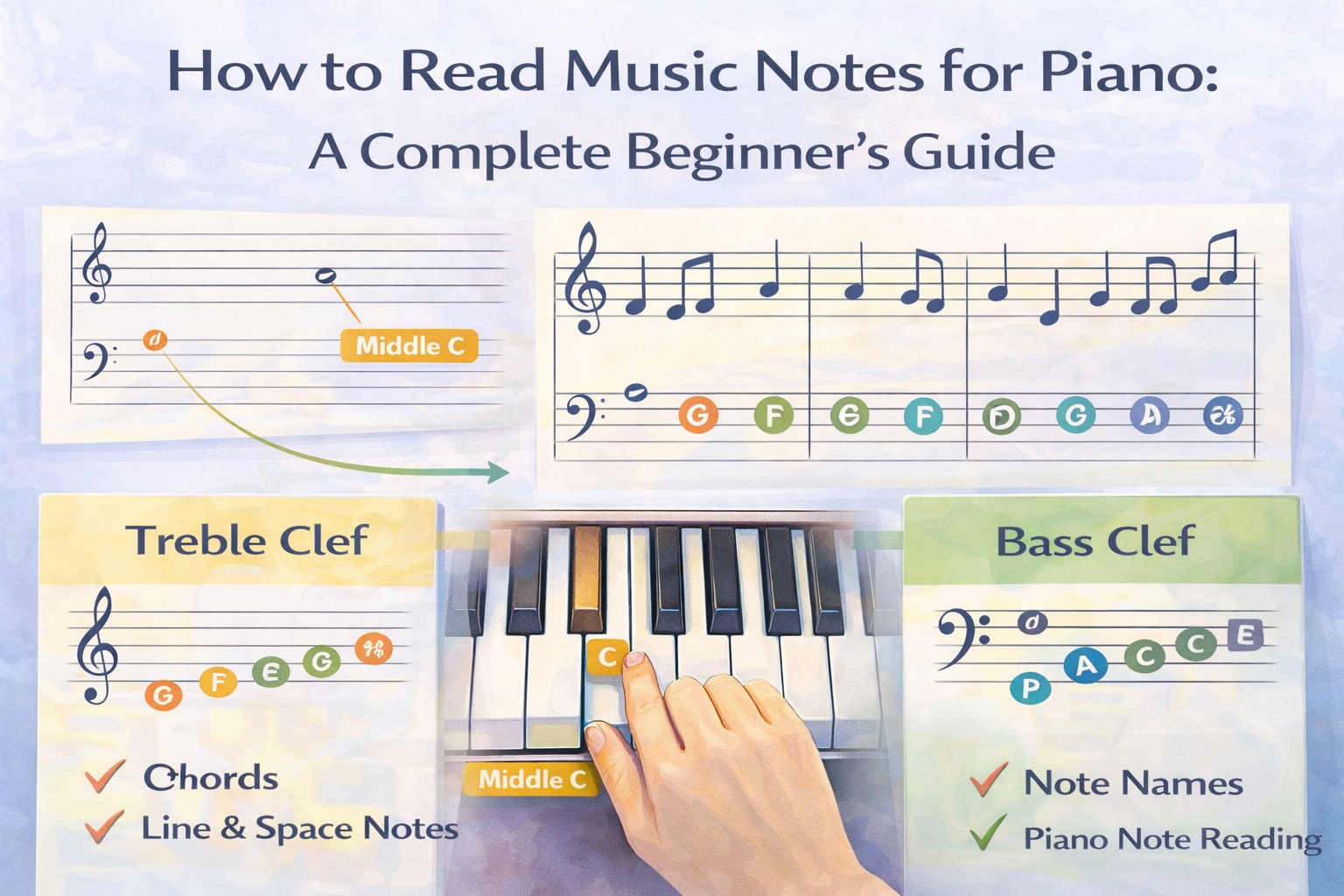
Learning how to read music notes for piano is one of the most important skills for any beginner pianist. While it may look confusing at first with lines, symbols, and unfamiliar markings, music notation follows clear rules that anyone can learn with the right approach.
This complete beginner’s guide will walk you step by step through reading piano notes, understanding sheet music, and confidently finding notes on the piano keyboard.
Introduction to Reading Music Notes for Piano
Many beginners feel overwhelmed when they first see piano sheet music. The good news? You don’t need to memorize everything at once. Reading music is a skill built gradually—just like learning a new language.
Why Learning to Read Music Is Important
- Helps you play new songs independently
- Improves rhythm, timing, and coordination
- Makes learning advanced piano techniques easier
- Allows you to understand music theory basics
Learning Stat
Studies in beginner piano education have shown that students who practice note reading daily can improve their recognition speed by up to 60% within the first 4–6 weeks.
Understanding the Basics of Music Notation
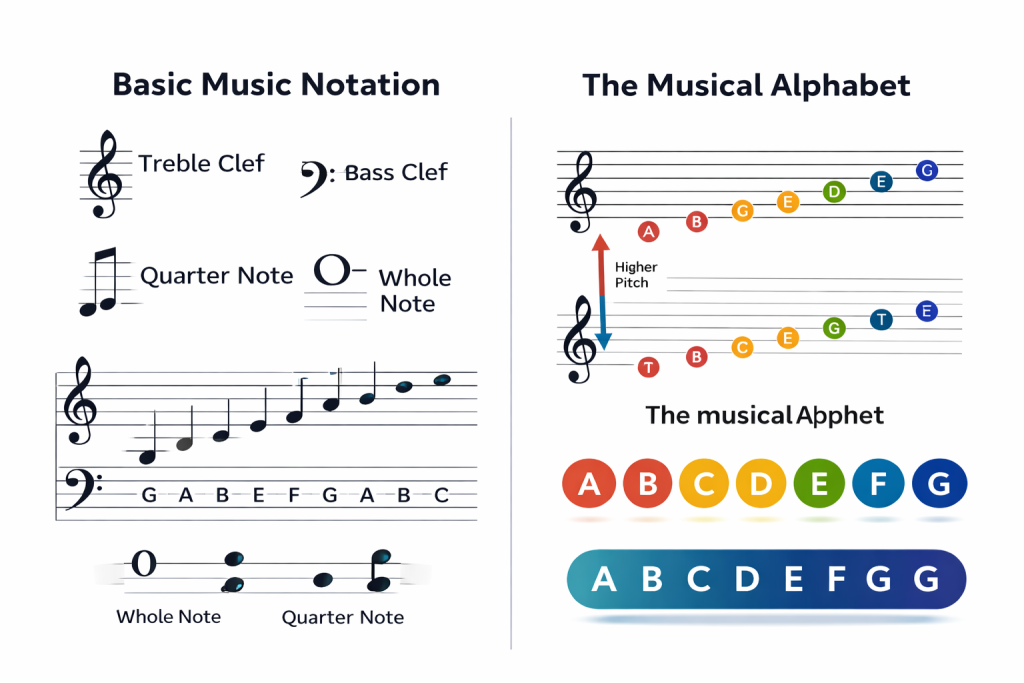
The Musical Alphabet (A–G)
Music uses only 7 letters:
A, B, C, D, E, F, G
After G, the pattern repeats at A.
| Musical Pattern | Example |
|---|---|
| Notes repeat | A B C D E F G → A B C |
| Same note, higher pitch | C → C (octave higher) |
The Piano Staff Explained
The staff is the foundation of sheet music. It consists of five horizontal lines and four spaces, and each line or space represents a note.
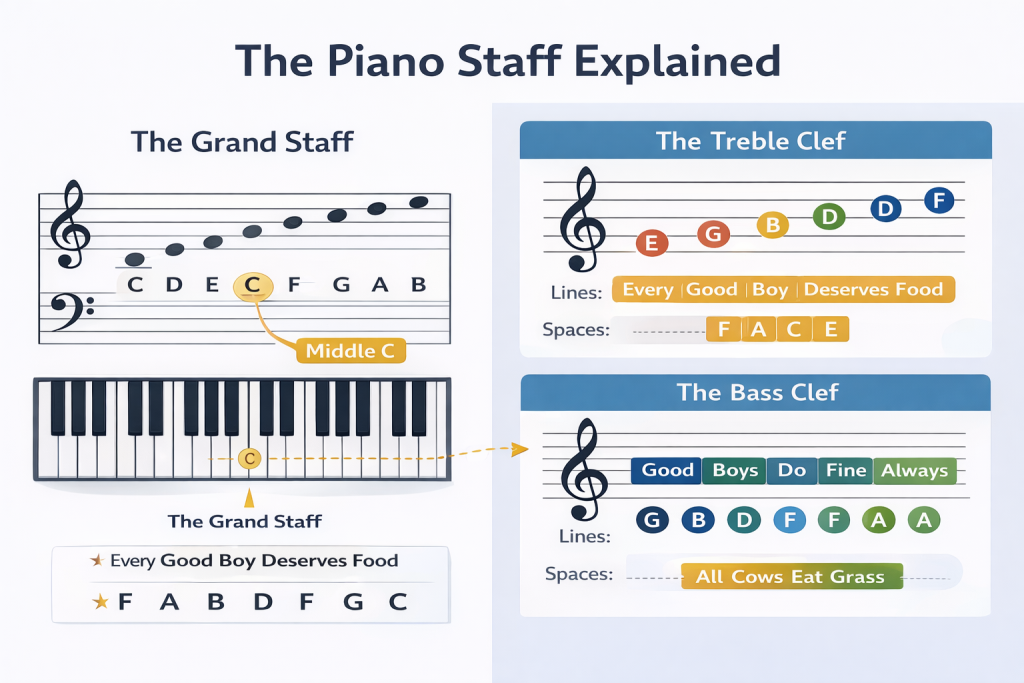
The Grand Staff
Piano music uses a grand staff, which includes:
- Treble clef → right hand (higher notes)
- Bass clef → left hand (lower notes)
They are connected by Middle C, the central reference note on the piano.
Treble Clef Notes (Right Hand)
The treble clef is usually played with the right hand.
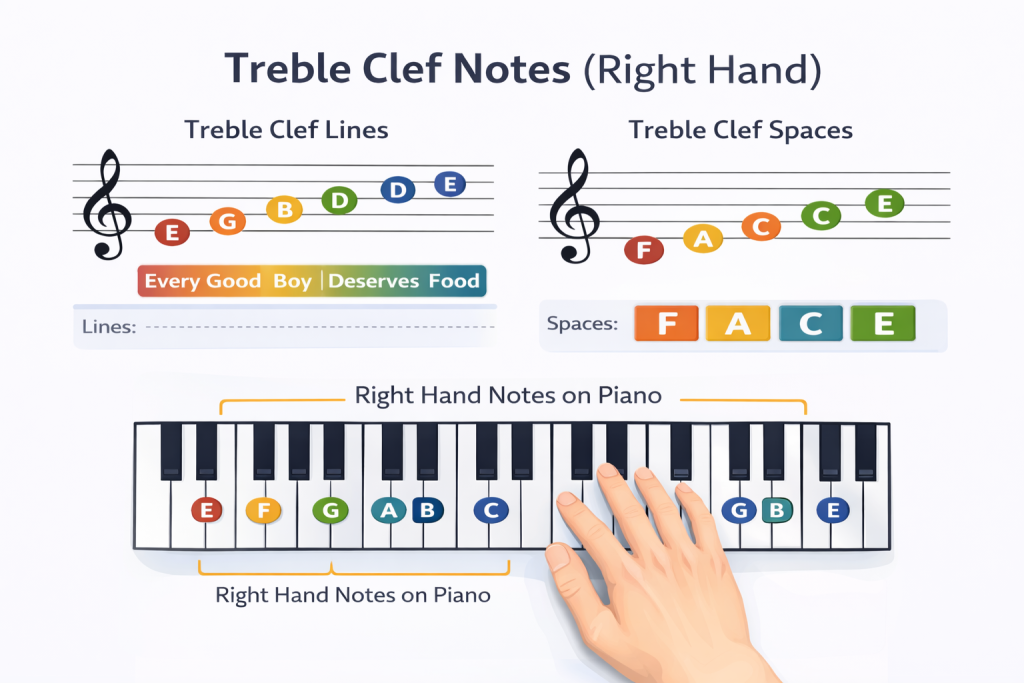
Treble Clef Notes on Lines and Spaces
| Position | Notes | Memory Tip |
|---|---|---|
| Lines | E – G – B – D – F | Every Good Boy Deserves Food |
| Spaces | F – A – C – E | FACE |
Bass Clef Notes (Left Hand)
The bass clef is typically played with the left hand.
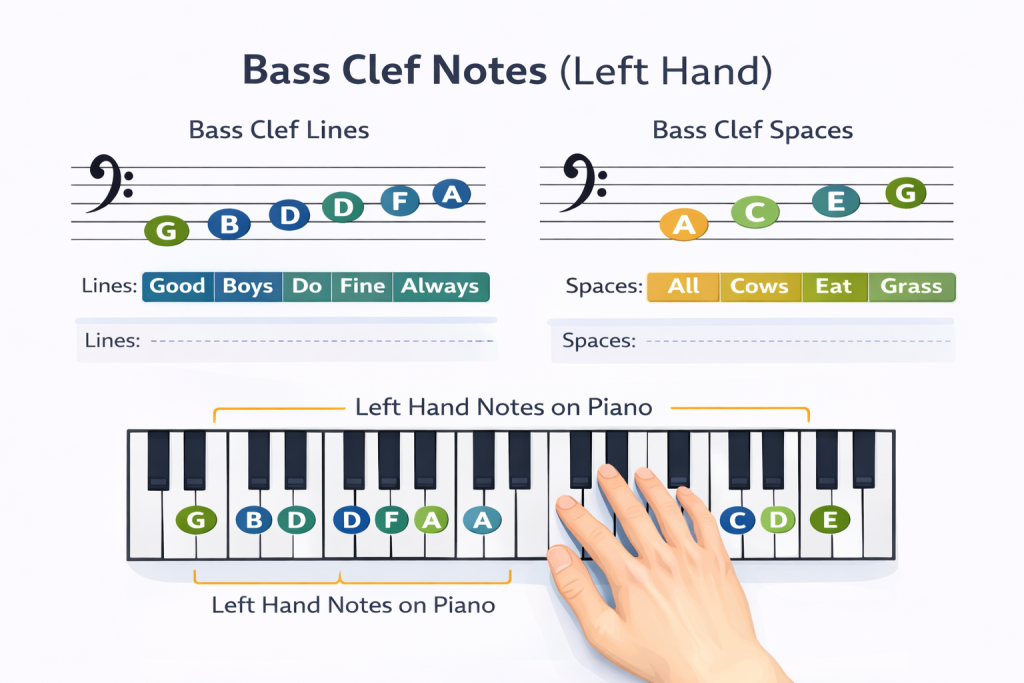
Bass Clef Notes on Lines and Spaces
| Position | Notes | Memory Tip |
|---|---|---|
| Lines | G – B – D – F – A | Good Boys Do Fine Always |
| Spaces | A – C – E – G | All Cows Eat Grass |
Finding Music Notes on the Piano Keyboard
Understanding Black and White Keys
- Black keys are in groups of 2 and 3
- The white key just before the group of two black keys is C
- Middle C sits near the center of the keyboard
Connecting Sheet Music to the Keyboard
- Notes higher on the staff → move right on the keyboard
- Notes lower on the staff → move left on the keyboard
Note Values and Rhythm Basics
Reading notes is not just about pitch it’s also about time and rhythm.
Common Note Values
| Note Type | Beats (4/4 Time) |
|---|---|
| Whole note | 4 beats |
| Half note | 2 beats |
| Quarter note | 1 beat |
| Eighth note | ½ beat |
⏱ Beginner Tip: Clap rhythms before playing them on the piano to build timing accuracy.
Time Signatures Made Simple
A time signature tells you:
- How many beats are in each measure
- Which note value gets one beat
Common Time Signatures for Beginners
| Time Signature | Meaning |
|---|---|
| 4/4 | 4 beats per measure (most common) |
| 3/4 | Waltz-style rhythm |
| 2/4 | March-like rhythm |
Sharps, Flats, and Key Signatures
Accidentals Explained
- Sharp (♯) → raises a note by one half step
- Flat (♭) → lowers a note by one half step
- Natural (♮) → cancels sharps or flats
Key signatures appear at the beginning of the staff and tell you which notes are consistently sharp or flat throughout the piece.
How to Read Piano Sheet Music Step by Step
Beginner-Friendly Approach
- Identify the clef
- Find Middle C
- Read one hand at a time
- Count rhythm out loud
- Combine hands slowly
📈 Progress Insight
Most beginners can comfortably read basic piano sheet music within 6–8 weeks with 15–20 minutes of daily practice.
Common Beginner Mistakes
❌ Trying to play too fast
❌ Ignoring rhythm
❌ Memorizing instead of reading
❌ Skipping note-reading practice
✔ Solution: Slow, consistent practice beats speed every time.
Tools and Resources for Beginners
| Tool Type | Benefit |
|---|---|
| Beginner piano books | Structured learning |
| Note-reading apps | Fast recognition |
| Printable charts | Visual reinforcement |
| Metronome | Rhythm control |
Conclusion
Learning how to read music notes for piano may seem challenging at first, but it becomes easier with structured practice and patience. By understanding the staff, clefs, rhythm, and keyboard layout, you build a strong foundation that will support your entire piano journey.