

For many families in Glasgow, the idea of starting lessons can feel both exciting and slightly nerve-racking. A child might love sound, rhythm, and movement, yet still struggle to sit down, follow steps, or practise without reminders. That is where Glasgow Piano Tuition can feel like a practical place to explore piano for ADHD in a calm, structured, and supportive way.
Piano is not a cure for ADHD. It should never be sold as one. Still, the structure of music can be surprisingly useful. A piano lesson asks the learner to listen, wait, copy, try again, notice patterns, and turn tiny actions into a bigger piece of music. Those are the same kinds of skills that sit under executive function.
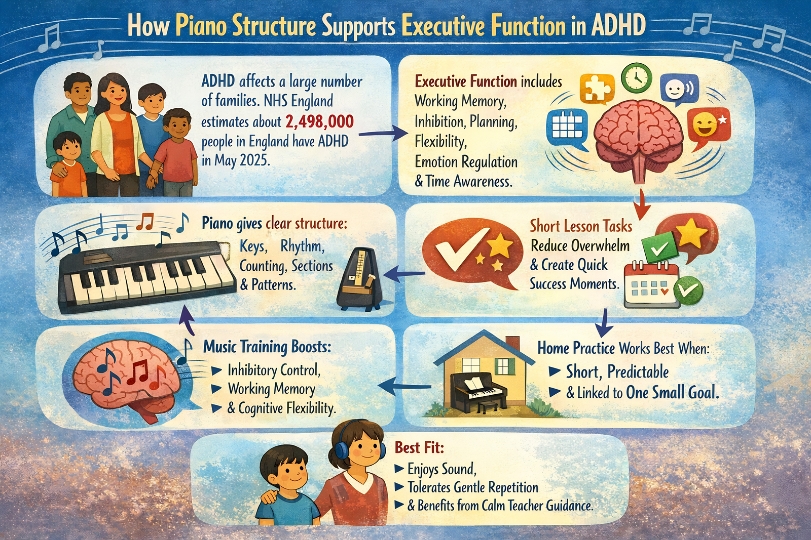
Executive function is the brain skill set that helps with planning, focus, working memory, impulse control, emotional regulation, and task switching. For someone with ADHD, those skills can feel harder to access, especially when a task is boring, too vague, or too long. Piano gives the brain something clearer to hold on to. In that sense, piano for ADHD is best understood as structured practice rather than a shortcut. There is a beat. There is a pattern. There is a start and finish.
Table of Contents
Quick facts for Glasgow families
Quick point | What it means
ADHD is common | NHS England estimated in May 2025 that about 2,498,000 people in England have ADHD, including people without a diagnosis, and 741,000 of these were children and young people aged 5 to 24.
Waiting lists are real | NHS England estimated that up to 549,000 people may have been waiting for an ADHD assessment in March 2025. Adult ADHD is not rare | NICE notes that ADHD prevalence in UK adults is estimated at 3% to 4%.
Music research is promising | A 2025 systematic review found positive effects of music training on inhibitory control, working memory, and cognitive flexibility in preschool children aged 3 to 6.
Results vary | A review of paediatric ADHD research notes that roughly 33% to 50% of children with ADHD show executive function impairments, which means needs differ a lot from one learner to another.
Why music structure can help the ADHD brain
Piano for ADHD works best when lessons are built around clear routines rather than pressure. A good lesson does not simply say, ” Practice harder. It breaks the task into small, visible actions.
Music is structured by nature. A beginner learns that the two- and three-black-key patterns repeat across the keyboard. A rhythm has counts. A melody has direction. A song has sections. For a learner who finds open-ended tasks stressful, that structure can be a relief.
There is also immediate feedback. Press the key gently and the sound changes. Play too fast and the rhythm wobbles. Slow down and the pattern becomes easier to hear. That feedback can be more motivating than a worksheet because the learner hears progress in the moment.
I’m honestly impressed by how much information a beginner manages at once when playing even a tiny phrase. They are reading or remembering notes, choosing fingers, listening to timing, and controlling movement. It looks simple from the outside, but the brain is doing a lot.
Executive function skills, piano can practise
The link between piano lessons and adhd is not about making symptoms disappear. It is about giving the learner repeated practice with skills that often need extra support.
- Working memory: remembering a note pattern, finger number, rhythm, or short instruction
- Inhibition: waiting for the count before playing, resisting the urge to rush, and stopping at the end of a phrase
- Planning: looking ahead to the next bar or section before starting
- Cognitive flexibility: changing from right hand to left hand, loud to soft, or slow to fast
- Emotional regulation: handling mistakes without giving up straight away
- Time awareness: feeling pulse, count, tempo, and practice length
These are not abstract ideas in a lesson. They are felt through sound and movement. That is why adhd and piano can make sense for some learners, especially those who learn better by doing than by listening to long explanations.
What makes the piano different from many other activities
In sports, drama, or group clubs, the learner may need to manage many social cues at once. Piano can be quieter and more contained. The keys stay in the same place. The pattern repeats. The teacher can slow the pace of the task without the learner feeling left behind by the whole group.
That does not mean piano is easy. It can be frustrating. Some learners dislike repetition. Others love playing by ear but resist reading notes. A few want to jump straight to full songs before their fingers are ready. I feel a bit relieved when teachers are honest about this, because it sets realistic expectations from the start.
For a learner with ADHD, the best lesson often includes variety within a reliable routine. In Glasgow, piano lessons for ADHD can work especially well when they are paced around the learner rather than a fixed book.
How structured piano lessons support attention
Attention is not just sitting still. For ADHD learners, attention often improves when a task has interest, novelty, movement, feedback, and a clear goal. Piano can offer all five.
A child who struggles to focus on homework for ten minutes may focus longer when the task is made sound. An adult who finds planning difficult may still enjoy building a song piece by piece. The sound gives the brain something to track.
Piano for ADHD can also make focus visible. Instead of saying, “Pay attention,” the teacher can say, “Listen for the soft ending,” or “Keep the left hand steady while the right hand moves.” That is much more specific. Specific instructions are easier to act on.
Recent research supports the idea that music training can be linked to gains in executive function, although the strength of the evidence varies by age, task, and study design. One 2024 meta-analysis found that music training improved inhibitory control in children across 8 randomised controlled trials, with an effect size of g = 0.60.
What a good ADHD aware piano lesson looks like
Some parents search for ADHD piano lessons because they want a teacher who understands that motivation is not the same as laziness. That matters. A learner may want to play and still find the steps difficult.
A supportive teacher might use:
- Short tasks with clear endings
- Visual cues and simple language
- Movement breaks
- Choice between two practice options
- Repetition that feels like a game
- Praise for process, not only performance
- Gentle reset moments after frustration
An ADHD-friendly piano approach works best when the teacher notices what helps the learner return to the task. Maybe it is tapping the rhythm first. Maybe it is playing a duet with the teacher. Maybe it is starting with a favourite tune before moving into reading.
The phrase “piano adhd” sounds a bit awkward, but it raises a real question. How do we make music learning fit the learner instead of forcing the learner to fit one rigid method?
The role of routine at home
Lessons are only part of the picture. Home practice matters, but it should not become a daily battle. For many ADHD learners, five calm minutes beat thirty stressful ones.
Try this simple practice structure:
- Put the music and pencil in the same place every day
- Practise at a predictable time, such as after a snack
- Start with the easiest pattern first
- Use a timer for a short session
- End with something the learner enjoys
- Keep a tiny win record, such as three stars for three practice days
The goal is not perfection. The goal is to start, return, and finish. Those are executive function skills in action.
When we talk about ADHD and learning piano, it helps to think in weeks and months, not in a single perfect practice session. Progress may look uneven. Some days will click. Other days will not. That is normal.
Choosing the best method
Parents often ask about the best piano method for ADHD. The honest answer is that no single method fits every learner. The best method is usually the one that combines structure, flexibility, interest, and a teacher who can adjust in real time.
For one child, colour-coded notes may help. For another, colour becomes distracting. One learner may love classical pieces. Another may need film music, game themes, or simple improvisation before reading feels meaningful.
Learning piano with ADHD often works better when the teacher builds from strengths. If the learner has a great ear, use it. If they love patterns, use scales and chords. If they need movement, include clapping, stepping, and rhythm games.
Teaching piano to students with ADHD also requires patience from adults. A teacher or parent may need to repeat instructions in a different way, not just more loudly.
How Glasgow Piano Tuition compares with other options
Option | Best fit | Strengths | Limitations
Glasgow Piano Tuition | Glasgow learners who want personal support and clear lesson structure | Local focus, individual guidance, room for tailored pacing, useful for families who want a teacher-led plan | Not a replacement for clinical ADHD support, and may not suit learners who strongly dislike piano or cannot attend regular lessons
School music lessons | Children already involved in school activities | Familiar setting, lower extra travel, useful social context | Less individual time, lesson pace may depend on class size and school timetable
Self-guided app or video learning | Teens or adults who are highly self-motivated | Flexible timing, low pressure, easy to repeat lessons | Less accountability, limited personal feedback, can be hard for ADHD learners who need structure
Community group music class | Learners who enjoy social energy | Fun, shared motivation, chance to play with others | More noise and distraction, less individual adjustment
This comparison is important because Glasgow Piano Tuition is not the only route. It may be a strong fit for learners who benefit from patient one-to-one instruction in Glasgow, but an app or a school route can work better for people who need a lower-cost starting point or a very flexible schedule.
When to consider a trial lesson
A trial lesson can reduce the pressure. Instead of asking, ” Will this work forever, you can ask, ” Did the learner feel safe, interested, and willing to try again?
If you are curious, free classes with Glasgow Piano Tuition can be a gentle way to explore whether structured lessons feel right before making a bigger commitment.
During the first lesson, look for signs such as:
- The teacher gives short, clear instructions
- The learner is allowed to make mistakes without shame
- The lesson includes small wins
- The teacher notices attention shifts without turning them into a big problem
- Practice advice feels realistic for your home life
I would be sceptical of anyone promising that piano will fix ADHD. I would be much more confident in a teacher who says,” Let us find a structure that helps this learner focus, enjoy music, and build confidence step by step.
What learners may actually gain
Piano for ADHD may support more than musical skill. The learner might begin to see that practice can be broken down. They may learn that mistakes are information, not failure. They may discover that focus can be built through interest rather than forced through pressure.
For children, this can feel empowering. For teens, it can become a private place to reset. For adults, it can be a calm routine after a scattered day.
Of course, every learner is different. ADHD can come with anxiety, dyslexia, autism, sleep issues, sensory needs, or other factors. That is why careful teaching matters. Music can be part of a wider support plan, but it should sit alongside school support, family routines, medical advice when needed, and realistic expectations.
Practical tips for parents and adult learners
Here are simple ways to make lessons more ADHD friendly:
- Keep practice short and frequent
- Ask for one clear home goal from each lesson
- Use rhythm before note reading when focus is low
- Celebrate returning to the task after a mistake
- Let the learner choose one fun piece alongside skill work
- Keep the piano area tidy and easy to start
- Avoid turning every practice into a test
People sometimes search for ADHD piano Reddit because they want real stories from other families. That makes sense. Lived experience can be comforting. Just remember that one person’s brilliant method may not fit your learner, and that is okay.
Final thoughts
Piano for ADHD is not magic, but it can be meaningful. The structure of music gives attention somewhere to land. The keyboard gives patterns the learner can see and hear. The lesson routine gives practice in starting, stopping, waiting, remembering, and trying again.
For Glasgow families, the most important thing is to look for a teacher who is patient, flexible, and honest. If a learner feels supported, a piano lesson can become more than a music activity. It can become a weekly practice in confidence and self-management. To explore whether this approach fits your child, teen, or your own learning style, visit Glasgow Piano Tuition and start with a conversation about needs, goals, and what a realistic first step could look like.