
Modern life places constant pressure on the mind. Work deadlines, financial concerns, digital overload, and emotional fatigue quietly build stress that often turns into anxiety. While many people search for quick fixes, one of the most effective long-term solutions is surprisingly simple: playing the piano.
Known as piano therapy, this practice uses music as an active form of mental and emotional healing. It engages the brain, relaxes the body, and allows emotional expression all at once. Unlike passive activities such as watching TV or scrolling on a phone, piano playing creates deep neurological calm while improving focus and mood.
Over time, even short daily sessions can significantly lower stress levels and improve emotional resilience.
How Piano Playing Instantly Calms the Nervous System
When your fingers touch the keys, your body naturally shifts into a relaxed state. Breathing slows, heart rate stabilizes, and the brain moves away from anxious thought loops into focused awareness.
This happens because of piano playing:
• Requires present-moment concentration
• Uses rhythmic movement that relaxes muscles
• Creates soothing sound feedback
• Engages emotional expression
Together, these trigger the body’s natural relaxation response — similar to meditation but often easier for beginners to maintain.
Many people feel noticeably calm within just minutes of playing.
The Science Behind Piano Therapy
Neuroscience shows that music activates multiple brain regions at once — including areas responsible for emotion, movement, memory, and attention. Active music-making is especially powerful because the brain produces sound while processing it in real time.
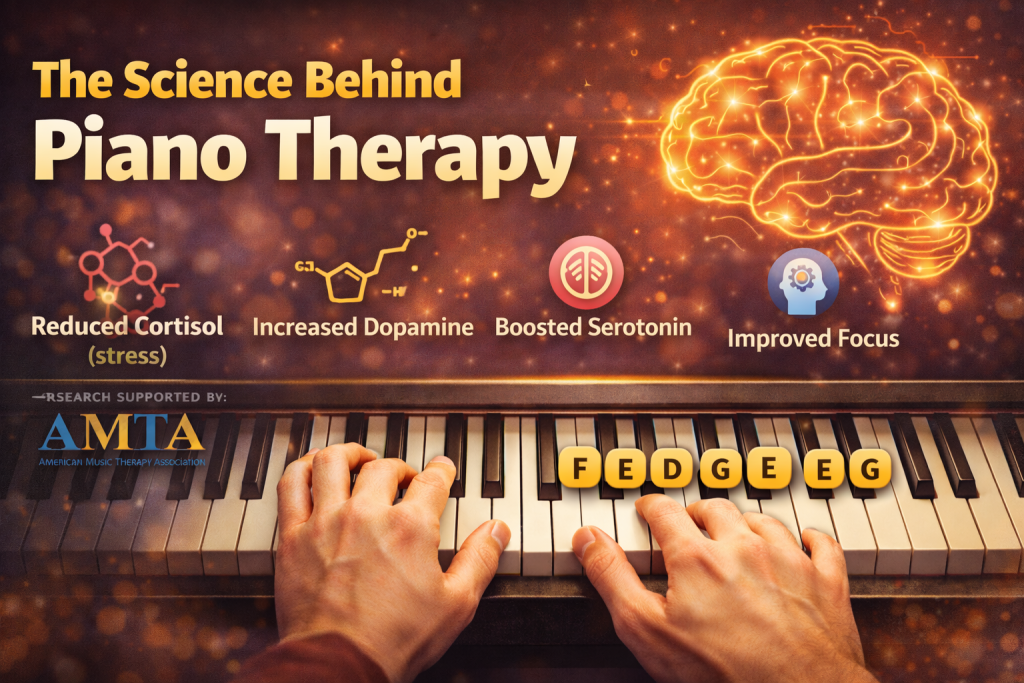
Research supported by the American Music Therapy Association confirms that playing instruments can:
- Reduce cortisol (stress hormone)
- Increase dopamine and serotonin (mood boosters)
- Improve emotional regulation
- Strengthen focus and memory
This is why piano therapy is now widely used in mental health treatment, rehabilitation, and stress recovery programs.
Stress often builds when emotions have no outlet. Piano playing provides a powerful non-verbal release.
Soft melodies can soothe sadness.
Strong chords release frustration.
Flowing progressions create peace and stability.
Instead of storing tension in the body, music allows emotions to move and resolve naturally. Many players report feeling lighter, calmer, and emotionally refreshed after each session.
Key Mental Health Benefits of Piano Therapy
Immediate effects:
- Reduced tension in muscles and breathing
- Clearer thinking
- Lower anxiety levels
- Improved mood
Long-term benefits:
- Stronger emotional control
- Better sleep quality
- Increased focus
- Lower chronic stress
- Higher confidence
Piano Therapy vs Other Stress Relief Methods
| Method | Mind Focus | Body Relaxation | Emotional Release | Sustainability |
|---|---|---|---|---|
| Deep breathing | Medium | Medium | Low | Medium |
| Meditation | High | Medium | Medium | Hard for some |
| Exercise | Medium | High | Medium | Energy dependent |
| Piano therapy | High | High | High | Enjoyable long-term |
Piano therapy stands out because it combines mindfulness, movement, creativity, and pleasure — making it easier to stick with consistently.
How Just 10–15 Minutes a Day Helps
You don’t need long sessions to benefit. Short focused playing can reset your nervous system quickly.
A simple calming routine:
• Slow warm-up notes (2 minutes)
• Gentle chord progressions (5 minutes)
• Favorite melody (5 minutes)
• Free relaxed playing (3 minutes)
This creates a full mental reset in under 15 minutes.
Who Should Try Piano Therapy?
Piano therapy is especially helpful for:
✔ Busy professionals with burnout
✔ Students under academic pressure
✔ People experiencing anxiety
✔ Seniors improving cognitive health
✔ Anyone seeking emotional balance
No musical experience is required — even basic notes create therapeutic effects.
Mistakes That Reduce Its Calming Power
Avoid turning piano into pressure by:
- Playing too fast
- Chasing perfection
- Comparing progress
- Practicing when tense
Slow, relaxed, enjoyable playing delivers the strongest benefits.
Bonus: Combine Piano With Breathing
Try inhaling slowly before a phrase and exhaling while pressing the keys. This synchronizes music with the body’s relaxation response and deepens calm almost instantly.
Final Thoughts
Piano therapy is one of the most enjoyable and scientifically supported ways to reduce stress and anxiety naturally. By engaging the brain, relaxing the body, and releasing emotions through sound, it creates a deep mental balance that few activities can match.
Even a few minutes daily can:
🎹 Calm racing thoughts
🎹 Improve emotional health
🎹 Reduce stress hormones
🎹 Strengthen focus
🎹 Create inner peace
In a stressful world, the piano becomes a personal space of calm and healing.