
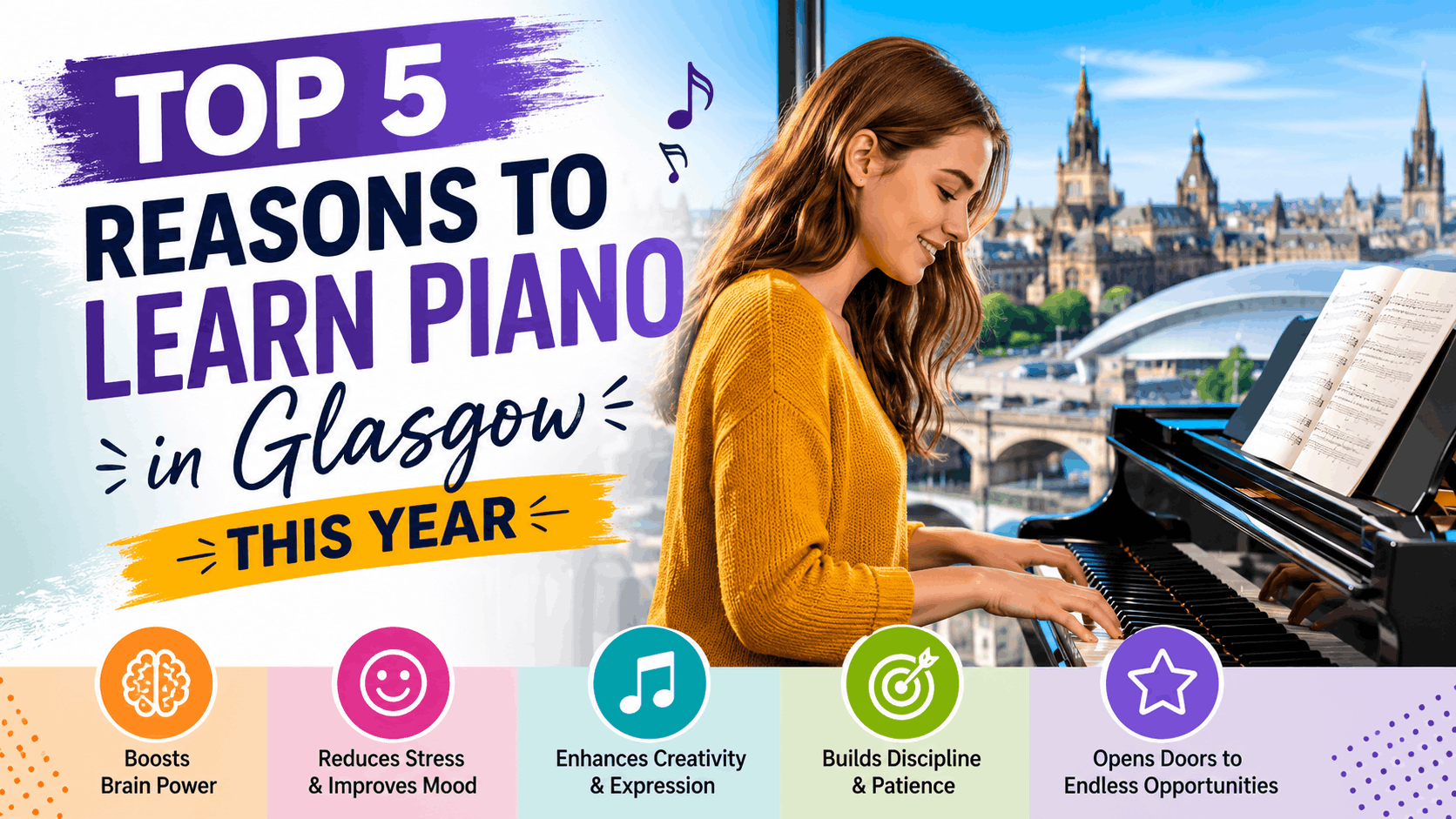
If you’ve been putting off learning piano, this is the year to stop waiting. Glasgow has quietly become one of Scotland’s most exciting cities for music education, with world-class teachers, thriving performance venues, and lesson formats flexible enough to fit around a full-time job, a school timetable, or a chaotic family schedule. Whether you’re a parent looking for your child’s first instrument, a working adult chasing a long-postponed hobby, or a retiree wanting a new mental challenge, Glasgow gives you more reasons than most cities to finally sit down at the keys.
This article breaks down exactly why — with real detail on teachers, culture, learning formats, exams, and costs — so you can decide if this is the year you start. At Glasgow Andy Piano, we work with beginners, returning players, and exam candidates across the city every week, so a lot of what follows is drawn from what actually helps students stick with lessons, not just generic advice you’d find anywhere. You can explore lesson options any time on our Glasgow piano tuition homepage.
Why Piano Lessons Are Booming in Glasgow Right Now
The Rise of Music Education in Scotland
Scotland has invested heavily in instrumental music tuition over the past decade, with local authorities including Glasgow City Council supporting access to music education in schools. Alongside this, private music schools and independent teachers have expanded to meet growing demand from adult learners — a demographic that has grown significantly since 2020 as people search for offline, screen-free hobbies. Piano remains one of the most requested instruments because it teaches music theory, rhythm, and harmony simultaneously, giving learners a foundation that transfers to almost any other instrument.
Glasgow’s Growing Reputation as a Music City
Glasgow is a UNESCO City of Music, a title that reflects its dense concentration of orchestras, venues, festivals, and conservatoire-level training. This isn’t a city where music is a side interest — it’s part of the civic identity. That environment matters for learners: being surrounded by working musicians, regular concerts, and a culture that takes music seriously tends to keep students motivated in a way that isolated, small-town learning often doesn’t.
Reason 1: Access to Highly Qualified Piano Teachers
Conservatoire-Trained Instructors
Glasgow is home to the Royal Conservatoire of Scotland (RCS), one of the UK’s leading conservatoires. Many piano teachers across the city trained at RCS or hold performance and pedagogy qualifications from it, meaning Glasgow learners have unusually easy access to instructors with genuine concert-level training — not just hobbyist tutors. This matters especially for students aiming for grade exams, music college auditions, or serious adult re-training.
Private vs. Group Piano Lessons in Glasgow
Not every learner needs — or wants — the same format. Here’s how the two main options compare:
| Feature | Private Lessons | Group Lessons |
|---|---|---|
| Pace | Fully personalised to the student | Fixed to the group’s average pace |
| Cost | Higher per hour | Lower per person |
| Feedback | Immediate, one-to-one correction | Shared attention, peer feedback |
| Social element | Minimal | Strong — good for children and beginners who want community |
| Best for | Exam preparation, fast progress, adult learners with specific goals | Young children, budget-conscious learners, those who thrive on group motivation |
| Flexibility of scheduling | High | Lower — fixed class times |
Most teachers in Glasgow offer a free or low-cost trial lesson, which is worth using to test personality fit before committing to a term. At Glasgow Andy Piano, trial lessons are structured specifically to assess a student’s current level, hand position, and goals before a teacher is matched — rather than just being a generic “meet and greet.” If you’d like to see how this works, you can book a trial lesson through our homepage.
Reason 2: Piano Playing Boosts Cognitive Development and Mental Health
Piano and Brain Development in Children
Learning piano requires reading two staves simultaneously, coordinating both hands independently, and processing rhythm, pitch, and dynamics in real time. Research in music cognition has repeatedly linked this kind of multi-tasking to improvements in:
- Working memory and executive function
- Fine motor coordination
- Mathematical and spatial reasoning
- Language processing and literacy skills
- Discipline and delayed gratification (through structured practice)
For children in Glasgow’s primary and secondary schools, piano lessons can complement — not compete with — academic development, particularly when practice is built into a consistent weekly routine.
Stress Relief and Mental Wellbeing for Adults
For adults, the benefits shift slightly. Piano practice functions as a form of active mindfulness: it demands enough concentration that work stress and daily anxieties are pushed out of focus, without requiring the physical exertion of exercise. Many adult learners in Glasgow cite stress relief, rather than performance ambition, as their primary reason for starting lessons — and teachers increasingly design adult-focused courses around enjoyment and relaxation rather than exam pressure. This is a big part of why Glasgow Andy Piano runs a separate adult-learner track: no grade-exam pressure unless the student specifically wants it, just steady, enjoyable progress at a pace that fits real life.
Reason 3: Glasgow’s Vibrant Music Culture and Performance Opportunities
Learning an instrument in a city with almost no live music scene is a very different experience from learning in one saturated with it.
Local Music Venues and Recitals
Glasgow offers students genuine, achievable performance goals:
- Glasgow Royal Concert Hall — home to the Royal Scottish National Orchestra and regular public recitals
- City Halls — a major venue for classical and chamber performances, including events by BBC Scottish Symphony Orchestra
- Local music school recitals — most established piano schools host termly student concerts, giving beginners low-pressure performance experience
Glasgow Andy Piano students perform at termly recitals for exactly this reason — having a real, low-pressure date on the calendar tends to keep practice consistent in a way that open-ended lessons rarely do.
Community Choirs, Ensembles, and Piano Competitions
Beyond formal venues, Glasgow has an active network of community choirs, chamber ensembles, and youth music competitions. Many piano students eventually branch into accompanying — playing for choirs, instrumentalists, or singers — which is one of the most in-demand (and often paid) skills a pianist can develop locally.
Reason 4: Flexible Learning Options — In-Person and Online
Piano Schools and Studios Across Glasgow Neighbourhoods
Glasgow’s piano teachers and studios are spread across the city, meaning most residents can find quality tuition close to home, including in areas such as:
- West End — a hub for independent music teachers and close to the University of Glasgow’s music-active student population
- Southside — home to several long-established community music schools
- City Centre — convenient for professionals fitting lessons around work
Glasgow Andy Piano covers students across these areas, matching them with a teacher based on location, learning goals, and personality fit rather than simply whoever has an open slot. Full coverage details are listed on the Glasgow Andy Piano homepage.
Online Piano Learning Platforms for Busy Schedules
For learners who can’t commit to a fixed weekly slot, many Glasgow-based teachers now offer online lessons via video call, alongside hybrid models (in-person plus app-based practice tracking). While online lessons can’t fully replace hands-on physical correction of posture and technique, they remove the single biggest barrier to consistency: travel time. For adults balancing work and family, this flexibility is often the deciding factor in whether lessons actually stick. Glasgow Andy Piano offers both formats side by side, so students aren’t forced to pick one permanently — many switch between online and in-person depending on the week.
Reason 5: Piano Skills Open Doors to Careers and Recognised Exams
Grading Systems and Certification Pathways
Most piano students in the UK — including Glasgow — work through one of two major exam boards:
| Exam Board | Recognition | Typical Focus |
|---|---|---|
| ABRSM (Associated Board of the Royal Schools of Music) | UK’s most widely recognised music exam board | Strong emphasis on technical rigour and theory |
| Trinity College London | Internationally recognised, UCAS-tariff points at higher grades | Slightly more flexible repertoire choices, strong performance focus |
Both offer graded exams (typically Grade 1 through Grade 8), and higher grades carry UCAS points — a genuine academic advantage for students applying to university, regardless of whether they pursue music formally. Glasgow Andy Piano prepares students for both ABRSM and Trinity exams, with teachers who track syllabus changes each year so students aren’t practising outdated repertoire lists.
Career Opportunities in Music Performance and Teaching
Piano proficiency opens doors well beyond the concert stage. Glasgow’s demand for skilled pianists spans:
- Private and school-based piano teaching
- Accompanying for choirs, instrumentalists, and vocal exams
- Session and studio work
- Music therapy (a growing field with training links to Scottish universities)
- Theatre, film, and events music
Because Glasgow has such a dense professional music network, students who reach a strong intermediate-to-advanced level often find local opportunities to earn from their skill far sooner than in less musically active cities.
How to Choose the Right Piano Teacher or School in Glasgow
Questions to Ask Before Enrolling
Before committing to a teacher or school, it’s worth asking (this is also the exact checklist our team uses when matching new students with a teacher at Glasgow Andy Piano):
- What qualifications or performance background does the teacher hold?
- Do they prepare students for ABRSM or Trinity exams, or focus purely on informal playing?
- Is there a trial lesson available?
- What’s the cancellation and rescheduling policy?
- Do they offer both in-person and online formats if your schedule changes?
- Is there an opportunity to perform at recitals or events?
Cost of Piano Lessons in Glasgow (Average Pricing)
Exact pricing varies by teacher experience and lesson format, but as a general guide:
| Lesson Type | Typical Price Range (per session) |
|---|---|
| Private lesson (30 min) | Lower-to-mid range, varies by teacher experience |
| Private lesson (60 min) | Roughly double the 30-minute rate |
| Group lessons | Generally the most budget-friendly per person |
| Online private lessons | Often slightly cheaper than in-person due to no studio overhead |
Because pricing changes frequently and varies significantly by teacher qualifications, it’s best to request current rates directly from two or three local teachers or schools before deciding.
Frequently Asked Questions About Learning Piano in Glasgow
What age should my child start piano lessons?
Most teachers recommend starting formal lessons between ages 5 and 7, once a child has the finger strength and attention span for structured practice. That said, informal keyboard play and music exposure can begin much earlier.
How much do piano lessons cost in Glasgow?
Costs vary by teacher qualifications, lesson length, and format (private vs. group, in-person vs. online). It’s best to compare quotes from a few local teachers, as rates are not standardised.
Can adults learn piano from scratch?
Yes. Adult beginners often progress faster than children in the early stages because they can understand and apply theory concepts more quickly, even if physical dexterity takes longer to develop.
Are online piano lessons as effective as in-person ones?
Online lessons work well for theory, repertoire learning, and general progress, especially for consistency. However, in-person lessons are generally better for correcting posture, hand position, and pedal technique in the early stages.
Conclusion: Start Your Piano Journey in Glasgow Today
Glasgow offers a rare combination for anyone considering piano: conservatoire-trained teachers, a genuinely active performance culture, flexible learning formats, and clear pathways from first lesson to recognised qualification. Whether your goal is a calmer mind, a musical child, a new adult hobby, or an actual career in music, few cities give you as much local infrastructure to support that goal.
The best next step is simple — book a trial lesson and see how it feels to finally start. Glasgow Andy Piano matches students across the city with teachers suited to their goals, schedule, and experience level, whether that’s a first lesson at age six or a return to the keys after twenty years away.