

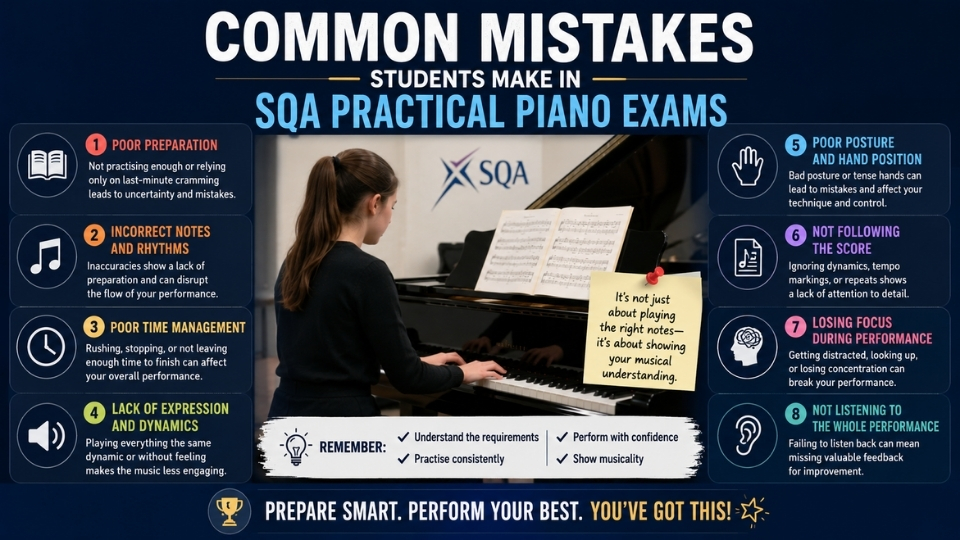
Music Theory Exams are an essential part of a student’s musical journey, especially for those preparing for SQA practical piano exams. While students often focus on their piano skills, many overlook the theory component, which can make a big difference in their overall performance. Understanding common mistakes can help students improve their music theory results and perform confidently on exam day.
In this article, we’ll explore the most common mistakes students make, provide practical tips, and suggest resources to help you excel in Music Theory Exams.
Table of Contents
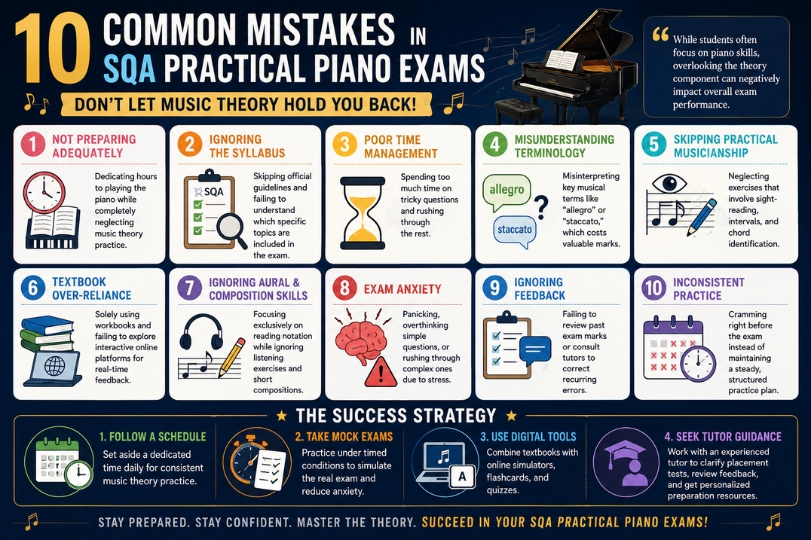
1. Not Preparing Adequately for the Theory Exam
One of the most frequent mistakes is insufficient preparation. Students often dedicate hours to piano practice but neglect their music theory practice. Theory exam questions are designed to test your understanding of musical structure, notation, harmony, and rhythm.
Many students fail to use available theory exam practice resources, such as online theory exam simulators or music theory practice test materials. Regular practice helps identify weak areas and improves accuracy in answering questions.
Tip: Set aside a dedicated time daily for music theory practice to ensure consistent progress.
2. Ignoring the Syllabus and Exam Requirements
Another mistake is skipping the official syllabus. Every music theory test follows a specific structure depending on the level, such as grade 5 theory or level 5 theory exams. Failing to understand what topics are included can lead to low scores.
Students should check their theory exam online guidelines or consult a tutor to ensure all topics, from key signatures to chord inversions, are covered. This is especially important for practical musicianship elements, which are often tested alongside written theory.
Resource: Visit Glasgow Piano Tuition for a clear breakdown of theory syllabuses and exam tips.
3. Overlooking Time Management During Exams
Many students spend too much time on tricky questions and rush through others, leading to mistakes in music theory practice exams. Proper time management ensures that you can attempt all questions carefully without feeling pressured.
Using mock theory exam papers or music theory test online simulators can help you practice pacing. This also allows you to simulate real exam conditions and reduce anxiety on the actual day.
4. Poor Understanding of Musical Terminology
A common pitfall is misunderstanding key musical terms. Questions in music theory online practice tests often include terms like “allegro,” “staccato,” or “modulation.” Misinterpreting these can cost valuable marks.
Students should refer to theory marking schemes and theory exam preparation resources to clarify definitions and examples. Flashcards or digital apps for music theory practice can be especially helpful for memorization.
Tip: Combine reading with listening exercises to understand how theory applies practically in music.
5. Not Practicing Sight-Reading or Practical Musicianship
In SQA practical piano exams, practical musicianship is assessed along with written theory. Students often neglect online theory practice exam exercises that incorporate sight-reading, intervals, and chord identification.
Practicing with a music theory practice test that mirrors the real exam scenario can help improve both written and practical skills. This ensures that students are well-prepared for sections that integrate theory with piano playing.
6. Relying Only on Textbooks
While music theory workbooks are valuable, solely relying on them can limit understanding. Many students fail to explore online music theory platforms or free practice materials that provide interactive lessons and real-time feedback.
Online theory exam preparation resources offer quizzes, video lessons, and practice sheets that mimic the real exam structure. Using a mix of textbooks and digital resources strengthens comprehension and confidence.
Resource: Try the free classes offered at Glasgow Piano Tuition Free Classes to get practical exposure and guidance.
7. Skipping Composition and Aural Skills
Composition and aural skills are often overlooked in piano theory exams. Students focus mainly on reading notation or chord theory, but ignore writing short compositions or identifying intervals by ear.
Music theory practice that integrates composition and listening exercises ensures better preparedness. Many online theory exam trial platforms provide aural exercises to enhance recognition skills.
8. Anxiety and Overthinking During Exams
Exam stress can affect performance. Many students panic during the online theory exam or while sitting for a practice test, leading to careless mistakes. Overthinking simple questions or rushing through complex ones reduces accuracy.
Tip: Take several mock exams to build familiarity and confidence. Practicing under timed conditions helps you remain calm during the actual theory exam online.
9. Mismanaging Theory Exam Marks and Feedback
Ignoring previous theory exam marks or failing to review theory result feedback is another mistake. Understanding where you lost marks in past music theory exams is crucial to improving performance in future exams.
Many students also fail to consult their tutors for clarification, missing opportunities to correct recurring errors. Using exam preparation resources like marking schemes and tutor guidance helps refine understanding.
10. Inconsistent Practice
Consistency is key to success in Music Theory Exams. Practicing sporadically or cramming before exams often leads to forgetting crucial concepts.
Setting up a structured plan with theory lesson sessions, online practice for the theory exam, and weekly mock exams ensures steady progress. Incorporate exercises covering G5 theory, theory 5, and level 5 theory content to cover all necessary topics.
Glasgow Piano Tuition Classes vs Competitor Classes
| Feature / Aspect | Glasgow Piano Tuition Classes | Competitor Piano Classes |
| SQA Exam Preparation | Comprehensive prep: practical musicianship, sight-reading, repertoire, and theory practice | Focus mainly on performance; minimal theory integration |
| Music Theory Support | Includes mock theory exams, practice tests, and theory marking guidance | Rarely includes theory; students practice separately |
| Feedback & Guidance | Personalized feedback; progress tracked for both piano and music theory exams | General feedback; limited exam tracking |
| Resources Provided | Access to workbooks, online theory practice, and mock exams | Basic practice sheets; minimal online resources |
| Exam Confidence | Mock SQA practical exams to build confidence | General feedback: limited exam tracking |
How to Avoid These Mistakes
- Follow a Study Schedule: Include daily music theory practice along with piano lessons.
- Use Online Resources: Platforms for online theory practice, music theory online exam, and theory online practice improve engagement and familiarity.
- Practice Mock Exams: Take mock theory exams to build exam confidence.
- Seek Tutor Guidance: Experienced tutors can clarify music theory placement tests and provide tailored exam preparation resources.
- Combine Practical and Written Learning: Integrate practical musicianship with written theory to strengthen understanding.
Conclusion
SQA practical piano exams are not just about piano performance; they require a strong foundation in theory. By avoiding common mistakes like neglecting music theory practice, misunderstanding terminology, or mismanaging time, students can significantly improve their music theory results.
Whether preparing for grade 5 theory, the ABRSM online theory exam 2026, or any online music theory practice exam, consistent practice, use of exam-preparation resources, and mock exams are essential. For students in Glasgow, Andy can provide personalized guidance through music theory tutoring to help them succeed confidently in Music Theory Exams.
For more guidance, visit Glasgow Piano Tuition and explore their free classes to boost your theory and practical skills.
FAQs
Q1. What are the most common mistakes in music theory exams?
Not practicing consistently, misunderstanding terminology, and neglecting aural skills.
Q2. How can I prepare for a grade 5 theory exam?
Use practice tests, mock exams, and consult exam preparation resources.
Q3. Are online theory exams different from in-person exams?
Online theory exams follow the same syllabus but include digital interfaces and timed practice modules.
Q4. How important is practical musicianship in theory exams?
It’s essential. Practical musicianship integrates theory with piano skills and is tested alongside written questions.
Q5. Can I improve my music theory results quickly?
Yes, by using mock exams, online theory practice, and consistent music theory practice guided by a tutor.