
A practical, honest guide for complete beginners in Glasgow: what the first year looks like, whether you need to read music, which piano to buy, and how to choose the right teacher.
Adult beginner piano lessons in Glasgow are for anyone who wants to learn piano from zero, whatever their age. You do not need to read sheet music, own a grand piano or have played an instrument before. With a patient teacher, a 15 to 20 minute daily practice habit and a clear plan, most adults are playing real, recognisable music within the first few months.
Key takeaways
- Age is not the barrier. Adults bring focus, patience and a reason for learning, which often makes up for the “head start” children have.
- You can start without reading music. Chord-based playing and playing by ear give quick, satisfying results alongside traditional notation.
- Consistency beats length. Twenty focused minutes a day outperforms a single two-hour session at the weekend.
- Your instrument matters. A weighted 88-key digital piano or an acoustic piano is far better than a small, light-touch keyboard.
- Try before you commit. A free taster lesson tells you more about a teacher than any website can.
Is it too late to learn piano as an adult?
No. This is the question almost every adult asks before booking a first lesson, and the honest answer is that there is no age limit on learning piano. People in their thirties, fifties, seventies and beyond start every year. What changes with age is not whether you can learn, but how you learn best.
Children tend to absorb new skills through repetition and imitation. Adults learn differently: they understand why something works, they can connect new ideas to what they already know, and they can organise their own practice. A good adult piano teacher uses those strengths. Instead of drilling you through a children’s method book, they explain how a major scale is built, why a chord sounds happy or sad, and how a song’s structure fits together. That understanding speeds things up.
It is also worth being realistic. Adult hands are less flexible than a seven-year-old’s, your time is limited by work and family, and you may be self-critical. None of these stop you progressing. They simply mean your plan should be efficient, enjoyable and flexible, which is exactly what a tailored, one-to-one approach provides.
Learning an instrument is a long-term, enjoyable habit rather than an exam you have to pass. The goal of your first year is not perfection. It is to reach the point where sitting at the piano feels natural and you can play music you actually love.
Why adults in Glasgow are learning piano
Glasgow has one of the richest music scenes in the UK. It is a UNESCO City of Music, home to the Royal Conservatoire of Scotland, the Royal Scottish National Orchestra and a busy calendar of gigs and concerts at venues such as the Glasgow Royal Concert Hall, Kelvingrove Bandstand and countless pubs and small venues across the West End, the Southside and the city centre. Living in a city that takes music seriously tends to inspire people to pick up an instrument themselves.
Common reasons adults give for starting piano lessons include:
- Stress relief and wellbeing. Focusing on playing is absorbing enough to pull attention away from work worries. Many learners describe their weekly lesson as protected time for themselves. Andy also offers a dedicated piano for wellbeing approach.
- A lifelong ambition. Lots of people had lessons as a child, stopped, and always wished they had continued. Returning to piano after years away is extremely common.
- Mental stimulation. Reading music, coordinating two hands and listening carefully all engage the brain in several ways at once. Researchers who study music and the brain often describe musical training as a rich form of cognitive exercise, although it is best seen as one healthy activity among many rather than a guarantee of any specific outcome.
- Creative expression. Once you know a handful of chords, you can accompany singing, improvise, or write your own songs.
- Social connection. Ensembles, evening classes and informal performances introduce you to like-minded people.
- Playing for family. Being able to play a carol, a favourite film theme or a Scottish tune at a family gathering is a lasting pleasure.
What happens in your first piano lessons
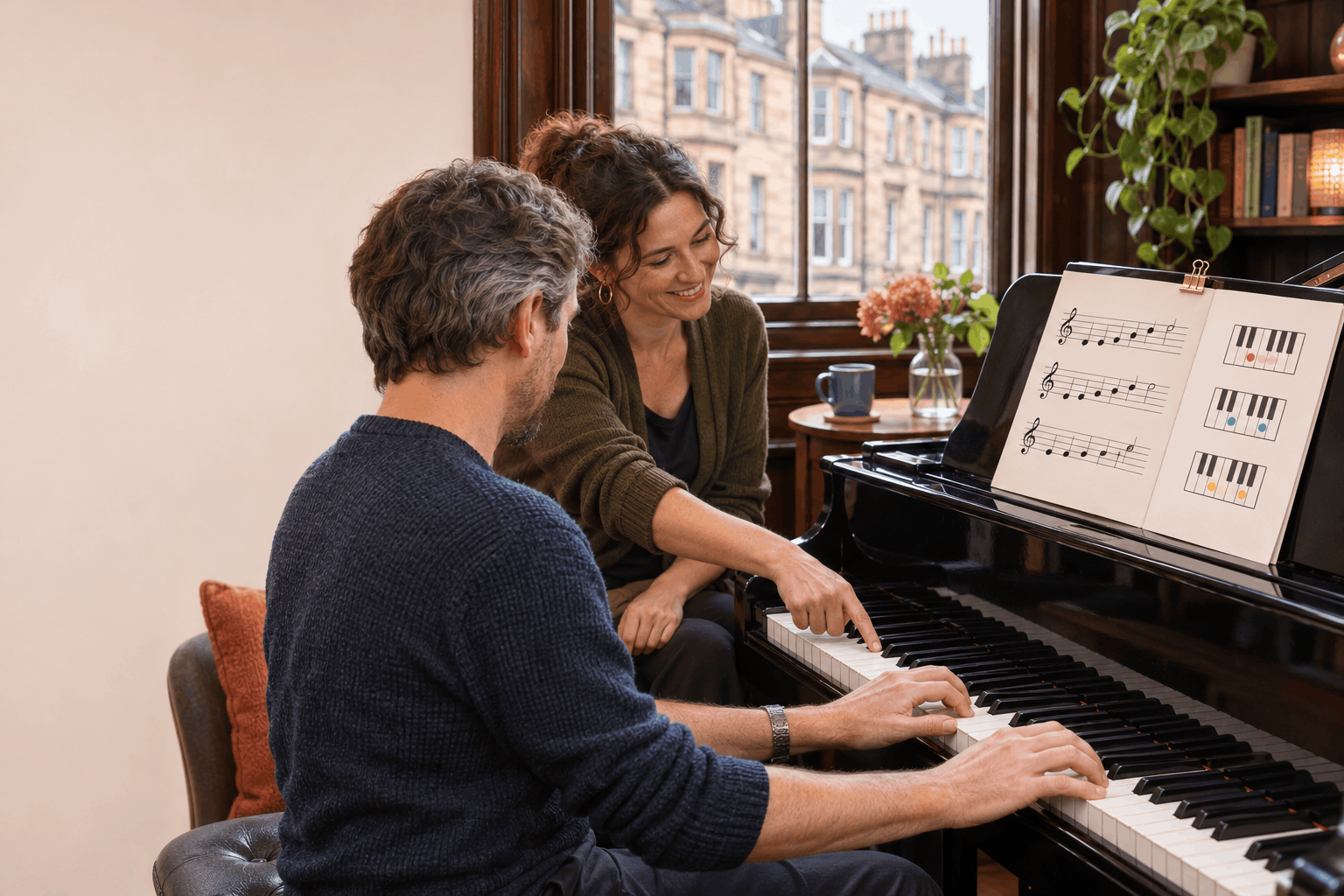
Walking into a first lesson as a complete beginner can feel nerve-wracking, so it helps to know what to expect. A well-structured first session is relaxed, practical and tailored to you rather than a test.
1. A conversation about your goals
Your teacher will ask what you want from piano. Do you want to play your favourite songs, learn to read classical scores, improvise jazz, accompany yourself singing, or write music? There are no wrong answers, and your goal shapes the whole programme.
2. Getting comfortable at the keyboard
You will learn the layout of the keys, the pattern of black and white notes and how to find Middle C. Your teacher will show you good posture, a relaxed wrist position and curved fingers, habits that protect your hands and make playing easier from day one.
3. Playing something straight away
Most beginners play a simple melody or a few notes of a chord pattern in the very first lesson. Making real music early builds confidence and motivation, which is far more useful than weeks of dry theory.
4. A short practice plan
You will leave with one or two small tasks, such as a five-finger exercise or a short tune, and a clear idea of how to practise them at home.
If you would like to experience this without any pressure, Andy offers a free, no-obligation 30-minute taster lesson where you can try the piano, ask questions and see whether the teaching style suits you.
Do you need to read sheet music to learn piano?
You do not need to read music before your first lesson, and you do not have to commit to a single way of learning. In practice, there are three complementary skills, and good teachers mix them to suit you.
Reading standard notation
Traditional staff notation (treble clef and bass clef) is the language of classical piano and the foundation of sight-reading. It opens up the huge repertoire of Bach, Mozart, Chopin and countless modern composers. It takes patience at first but becomes easier with regular practice and is very rewarding.
Playing from chords and lead sheets
A lead sheet or chord chart shows the melody plus chord symbols such as C, Am, F and G7. Once you understand how chords are built (major and minor triads, seventh chords, inversions), you can accompany almost any pop, folk, blues or jazz song. This is the fastest route to playing songs you recognise, which is why it suits many adult learners so well.
Playing by ear and improvising
Developing your ear means you can work out a tune you have heard and play it without a score. Improvisation, using scales and chord progressions to invent your own melodies, is a skill you can start building surprisingly early, particularly in jazz and blues styles.
Andy’s lessons cover all three, with notation, theory, improvisation and composition taught side by side so you are never locked into just one approach.
A realistic 12-month roadmap for adult beginners
Every learner progresses at a different pace, so treat this as a typical pattern for someone practising roughly 15 to 30 minutes most days, not a guarantee. Your own timeline depends on your practice, your goals and your starting point.
| Stage | What you typically work on | What you can usually play |
|---|---|---|
| Months 1 to 3 | Keyboard geography, posture, note names, basic rhythm, hands separate then together, first major scales, first chords (C, F, G). | Simple melodies and easy two-handed pieces; basic chord accompaniments for simple songs. |
| Months 4 to 6 | Reading rhythms and notes more fluently, minor chords, left-hand patterns, simple pedal use, steady tempo with a metronome. | Recognisable arrangements of favourite songs and beginner classical pieces. |
| Months 7 to 9 | Seventh chords, inversions, more scales, dynamics and phrasing, introduction to improvisation or sight-reading. | Fuller arrangements, short improvised phrases, early-grade repertoire. |
| Months 10 to 12 | Longer pieces, more expressive playing, chord progressions across keys, performing for others. | A confident personal repertoire of several pieces, and the ability to learn new ones more independently. |
Notice that the plan focuses on playing music at every stage. Technical skills such as scales and arpeggios are included because they make the music easier, not as a chore for its own sake.
Piano or keyboard at home: what should you buy?
Practising between lessons is where most progress happens, so the instrument you have at home matters. You do not need to spend a fortune, but you do need the right kind of instrument.
Option 1: An acoustic upright piano
An upright gives the most authentic touch and sound. Used instruments are widely available in the UK, but they need occasional tuning, space and a stable room environment. Neighbours are worth considering if you live in a Glasgow tenement or flat, since acoustic pianos are loud.
Option 2: A digital piano (usually the best choice for beginners)
Look for a digital piano with 88 fully weighted keys and graded hammer action, which mimics the feel of an acoustic piano. Reputable makers include Yamaha, Roland, Kawai and Casio. Digital pianos never need tuning, can be played silently with headphones (ideal for late-night practice) and take up less space. A proper sustain pedal and a stable stand or bench are important extras.
Option 3: A small portable keyboard
A 61-key keyboard with light, spring-like keys is fine as a temporary stepping stone, but it does not build the finger strength or touch control that piano repertoire needs. If a small keyboard is all you can manage at first, mention it to your teacher so they can plan around it.
Before buying anything, ask your teacher for advice. Andy’s lessons take place on a real grand piano, so you get the full experience of a concert-quality instrument in every lesson while building your skills on whatever suitable instrument you have at home.
How to practise piano as an adult (and actually stick to it)
The single biggest difference between adults who succeed and those who give up is not talent. It is having a simple practice routine they can keep. These habits help:
- Practise little and often. Fifteen to twenty minutes most days is more effective than a long weekend marathon. Attach it to something you already do, such as after your morning coffee or before dinner.
- Warm up with something easy. A scale or a piece you already enjoy settles your hands and your mind.
- Work on small sections. Isolate the hard two or four bars rather than replaying the whole piece from the start every time.
- Start slowly, then speed up. Slow, accurate playing builds the muscle memory that fast playing relies on. A metronome (or a free app) keeps your tempo honest.
- Hands separately first. Learn each hand alone, then combine them at a slow tempo.
- Record yourself. A quick phone recording reveals uneven rhythm and tension that you miss while playing, and lets you hear your own progress over weeks.
- End on something you enjoy. Finishing with a favourite tune keeps practice rewarding rather than a chore.
Missed a few days? That is normal. Simply restart the next day without guilt. A teacher who understands adult schedules will adapt your plan around holidays, work deadlines and busy weeks.
Choosing a style: classical, jazz, pop or Scottish
One of the great advantages of private tuition is that the music is chosen around you. Common directions for adult beginners include:
- Classical piano. Builds excellent technique and reading skills, from Bach Minuets to Beethoven and Debussy.
- Jazz piano. Focuses on chord voicings, swing rhythm, blues scales and improvisation. A rewarding style for adults who like creativity and freedom.
- Pop, rock and film music. Learn to play and accompany the songs you listen to every day using chords and simple arrangements.
- Scottish and folk tunes. Traditional melodies are a lovely way to connect with local music and are often easy to adapt for piano.
- Songwriting and composition. Using chord progressions to write original songs, and getting started with recording and music production.
You do not have to pick just one. Many students begin with a mix and find their preferred direction after a few months.
Graded exams or playing for pleasure?
Piano exams are optional for adults, and many learners never take one. The two main UK exam boards are ABRSM (Associated Board of the Royal Schools of Music) and Trinity College London. Both offer Grades 1 to 8, with each grade assessing pieces, scales and arpeggios, sight-reading and aural tests. ABRSM is closely linked to the Royal Schools of Music, including the Royal Conservatoire of Scotland.
Choose the exam route if you like clear targets, structured milestones and a certificate to show for your effort. Choose the free-playing route if your goal is simply to enjoy music, play songs you love and improvise without pressure. Andy’s piano lessons support both paths, so you can follow the graded route, skip exams entirely, or start without exams and decide later.
Remember that for ABRSM Grades 6, 7 and 8 you must have passed Grade 5 music theory (or another approved qualification) first, so if you ever aim that high, it is worth building your theory knowledge steadily along the way. Practical piano lessons with Andy include music theory taught in a practical, useful way.
Group course or one-to-one lessons?
Both formats work well, and the best choice depends on your personality and goals.
One-to-one lessons
Private lessons are fully personalised: the pace, the repertoire and the teaching approach all fit you. You receive immediate feedback on technique and posture, which is especially valuable in the first months when habits are forming. This is the most effective way to progress for most adult beginners.
Group evening course
A group course is more social and can feel less intimidating if you prefer to learn alongside others. Andy runs an Evening Piano Course: Chords & Charts, a group class held two evenings a week for six weeks (12 sessions of 60 to 90 minutes). It focuses on chords and chart reading, so you quickly learn how to accompany songs and play from lead sheets. Many people use it as a fun, low-pressure way to start before moving on to one-to-one lessons.
How to choose an adult piano teacher in Glasgow
There are many piano teachers across Glasgow, from independent tutors and local music schools to online platforms. Use this checklist to find the right fit:
- Experience with adult beginners. Teaching adults is different from teaching children. Ask how they adapt their approach.
- Real performing and teaching background. A teacher who actually performs, composes or records tends to bring practical, real-world musicianship to lessons.
- A flexible, goal-based approach. Avoid anyone who insists every student follows the same book from page one.
- The quality of the instrument. Lessons on a well-maintained, quality piano make a noticeable difference to your touch and ear.
- A trial lesson. A good teacher is confident enough to let you try before you commit.
- Clear communication. Look for transparent information about lesson length, scheduling, location and policies.
- Chemistry. You will spend many hours with this person. You should feel relaxed, encouraged and free to ask “silly” questions.
Common mistakes adult beginners make (and how to avoid them)
- Trying to play too fast. Speed comes from accuracy. Slow down and the quality improves quickly.
- Comparing yourself to others. Compare yourself with where you were a month ago, not with a child prodigy on social media.
- Skipping the basics. Rhythm, hand position and simple scales may feel dull, but they make everything afterwards easier.
- Only practising what you can already play. Spend most of your time on the tricky parts.
- Tensing up. Tight shoulders and wrists cause fatigue and discomfort. Stay relaxed and take breaks.
- Learning only from videos. Videos are useful, but they cannot spot a tense wrist or an uneven rhythm in your own playing. A teacher can.
- Giving up after a plateau. Progress is not a straight line. Slow patches are normal and are usually followed by a sudden jump forward.
Learn piano in Glasgow with Andy Alston
Andy Alston is a Glasgow-based pianist and composer who teaches one-to-one piano lessons for beginners through advanced players, covering classical, jazz, pop, improvisation, music theory, songwriting and composition. Lessons take place on a real grand piano, and students can follow a graded exam route or simply play for enjoyment. You can read more about Andy, explore the full range of services, or see how lessons for kids, teens and adults are structured.
If you are an adult who has always wanted to play, the simplest next step is to try a lesson and see how it feels.
Frequently asked questions about adult piano lessons in Glasgow
Can a complete beginner learn piano as an adult?
Yes. Many adult students start with no musical background at all. A good teacher begins with the very basics, such as the keyboard layout, posture and simple melodies, and builds from there at a pace that suits you.
How long does it take an adult to learn piano?
It depends on your goals and practice. With regular practice of around 15 to 30 minutes most days, many adults can play simple songs within a few months and feel comfortable with a small repertoire after about a year. Reaching an advanced level is a longer, ongoing journey, but enjoyment starts almost immediately.
Do I need to be able to read music before my first lesson?
No. You can learn to read music during lessons, or begin with chords and playing by ear. Many teachers, including Andy, combine notation, chords and improvisation so you can enjoy playing while you learn.
Do I need a piano at home?
You will make faster progress if you can practise between lessons. An acoustic piano or a digital piano with 88 weighted keys is ideal. Ask your teacher before you buy so you choose something suitable for your budget and space.
How much do adult piano lessons cost in Glasgow?
Prices vary depending on the teacher’s experience, lesson length and location, and 30-minute lessons are usually cheaper than hour-long ones. Contact Andy for current rates, and try the free 30-minute taster lesson first so you know exactly what you are getting.
Should I take piano exams as an adult?
Only if you want to. Exams from boards such as ABRSM and Trinity College London give you clear goals and a recognised qualification, but they are optional. Many adults prefer to play freely, improvise or write their own music instead.
Are evening piano lessons available in Glasgow?
Evening options are popular with working adults. Andy’s group Evening Piano Course: Chords & Charts runs two evenings a week for six weeks. For one-to-one lesson times, get in touch via the contact page to check current availability.
Is piano good for stress and mental wellbeing?
Many people find playing piano relaxing and absorbing, and use it as a way to unwind. It is not a medical treatment, but regular, enjoyable music-making can be a valuable part of a healthy routine. Learn more about piano for wellbeing.